
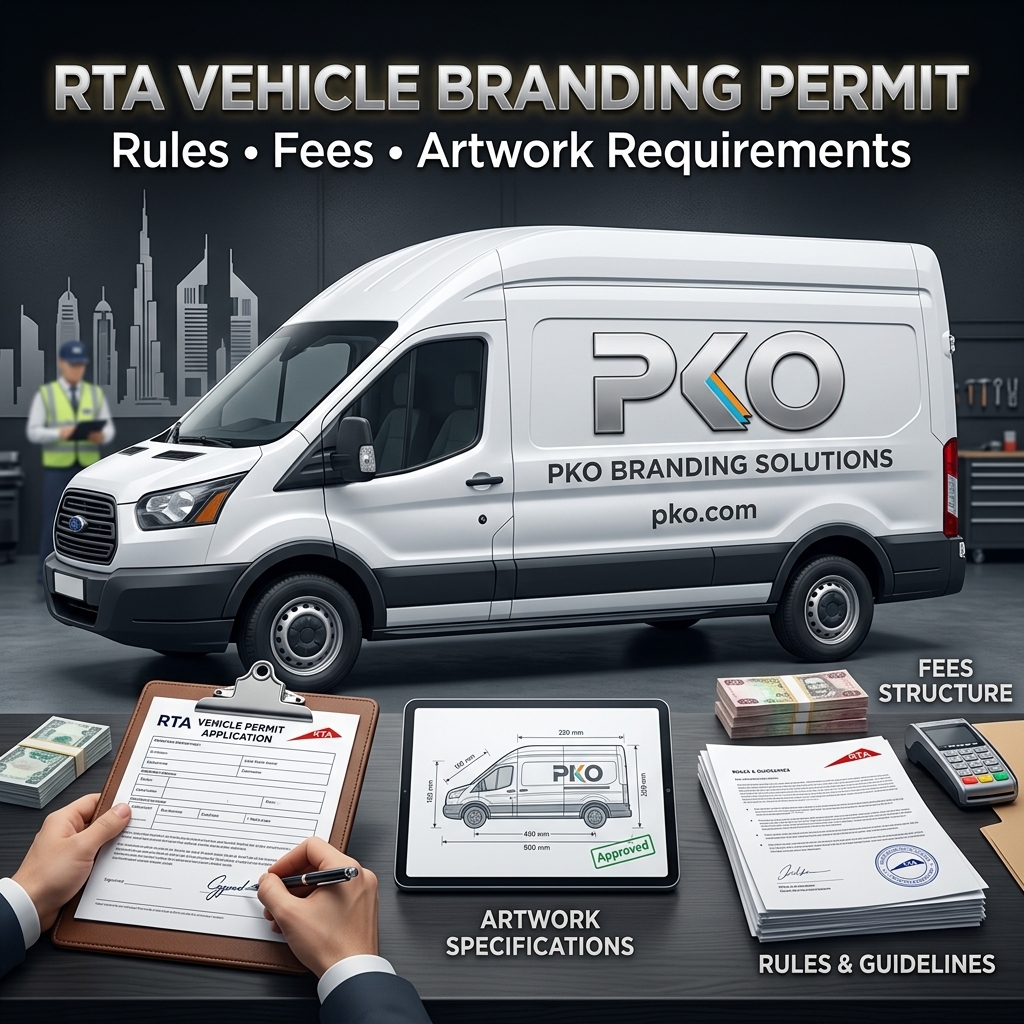
An RTA vehicle branding permit is the approval issued by Dubai’s Roads and Transport Authority that allows a business to display advertising, logos or graphics on a vehicle driven on Dubai’s roads. In most cases the artwork has to be approved before the vinyl is printed, not after it is installed.
That single detail is where most projects go wrong. A company signs off a design, sends it to production, and only then finds the layout, content or coverage does not meet the conditions attached to the permit. The wrap is reprinted and the schedule slips.
Requirements and fees are revised periodically and vary by vehicle category, so confirm the current position with the RTA before committing to printing.
What Is an RTA Vehicle Branding Permit?
An RTA vehicle branding permit is a formal advertising approval that permits commercial graphics on a vehicle registered and operating in Dubai. It confirms that the advertising content, its placement on the body of the vehicle and the vehicle itself meet the authority’s advertising and road safety conditions.
The permit covers three things:
- The vehicle, identified by its registration details
- The advertising content, reviewed as a submitted design
- The period of validity, after which it is renewed or cancelled
Vehicle branding in Dubai is the physical work of printing and applying vinyl graphics. The permit is the regulatory side of the same project, and it normally comes first.
When Do You Need Approval for Vehicle Branding in Dubai?
Check approval requirements any time commercial or promotional content will appear on the exterior of a vehicle. Typical situations include:
- Adding a company name, logo, phone number or website to a van, pickup or car
- Applying a full or partial wrap to a fleet
- Branding delivery, courier, logistics or service vehicles
- Running a third-party advertising campaign on vehicles you own or lease
- Changing existing branding to a new design, brand or campaign
- Renewing branding already on the road as its permit period ends
Three points are easy to overlook. Vehicles are normally expected to be registered under the company applying, so a car in an individual’s name is treated differently from a commercial vehicle. Leased vehicles usually need a no objection letter from the owner. Taxis, buses and public transport assets fall under separate arrangements, as do vehicles registered in another emirate.
RTA Vehicle Branding Permit Rules Businesses Should Know
Detailed conditions sit with the authority and can change, but the principles behind them are consistent and worth designing around from the start.
- Safety before visibility. Graphics should not obstruct the driver’s view, cover windscreens, or interfere with lights, indicators, mirrors or plates.
- The vehicle stays identifiable. Registration plates and statutory markings must remain fully readable.
- Content is reviewed, not just design. Offensive, misleading, political or religiously themed advertising is not accepted.
- Third-party brands need permission. Advertising someone else’s brand requires authorisation from the brand owner.
- Regulated sectors need extra clearance. Real estate, healthcare and education content often requires supporting approval.
- Optical effects are treated cautiously. Highly reflective finishes and three-dimensional illusions that could distract other drivers are generally discouraged.
- Arabic usually matters. Advertising in Dubai commonly needs Arabic content presented properly, so plan bilingual artwork rather than adding it late.
- Permits expire. Branding must be kept in good condition, and approvals are renewed or cancelled rather than left to lapse.
Documents Commonly Required for Vehicle Branding Approval
Requirements differ by permit category and vehicle type, but most applications draw on a similar set of paperwork.
- Valid trade licence for the applying company
- Vehicle registration card, often called the mulkiya, for each vehicle
- Advertising artwork showing the design on all relevant sides of the vehicle
- No objection letter from the vehicle owner or leasing company, where the vehicle is not owned outright
- Brand owner authorisation and trademark evidence when advertising a third-party brand
- Supporting approvals for regulated activities such as real estate or healthcare
- Applicant contact and authorised signatory details, with Emirates ID or passport copy where requested
Submit the artwork as clear, labelled visuals rather than a rough sketch. A reviewer who can see what goes where has fewer reasons to send it back.
RTA Vehicle Branding Permit Fees
There is no single flat fee for vehicle branding in Dubai, and any figure quoted without context should be treated with caution. Costs depend on:
- The vehicle category, since light vehicles, heavy vehicles, trailers and motorcycles are handled differently
- The extent of the branding, as a small logo and a full wrap are not assessed the same way
- Whether the advertising is for your own business or for a third party as a commercial advertising activity
- The permit duration and renewal cycle
- Administrative and government service charges, and the number of vehicles in the application
Published fee schedules for advertising permits in Dubai span a wide range, from modest amounts for a company name on a commercial vehicle to substantially higher annual figures for dedicated mobile advertising vehicles. Verify the current fee for your exact vehicle and advertising category through the RTA’s official channels before you budget.
Budget separately for the branding work itself. The permit is a government charge, while design, printing, materials and installation are a different line in the quotation.
Artwork Requirements for Vehicle Branding
Approval and production depend on the same file, so getting the artwork right serves two purposes at once.
Brand elements and placement
- Use correct logo files, not a version pulled from a website or presentation
- Keep company name, contact number and website consistent with your licence and other marketing
- Work from actual measurements of the specific make and model, not a generic template
- Map artwork around doors, handles, fuel caps, panel gaps and body curves, keeping glass, lights and plates clear
- Avoid clutter, since a vehicle is read in seconds at a distance
Image quality and production files
- Supply vector artwork where possible for logos and text
- Use high-resolution images scaled for large format output, since a photo that looks fine on screen can break down across a van panel
- Set colour up for print and specify brand colours precisely rather than relying on screen appearance
- Provide production-ready files with fonts outlined, bleed included and layers organised per panel
Readability and content
- Ensure text contrasts strongly with the background so it stays readable in bright daylight
- Consider how the design reads from behind, from the side and in moving traffic
- Keep advertising content consistent with exactly what was submitted for approval
Where the artwork also feeds other brand touchpoints, one team should handle it. The way we approach visual layouts for exhibition stand design is the same discipline: measure first, design to the real surface, then produce.
Common Artwork Mistakes That Cause Delays
- Low-resolution logos or images that pixelate once scaled to panel size
- Designs built on generic vehicle templates rather than the actual model
- Company details that do not match the trade licence, or are hard to read at speed
- Third-party brand content without written authorisation
- Key messaging placed across door handles, panel gaps or heavily curved sections
- Missing or poorly translated Arabic content added as an afterthought
- Colours specified for screen rather than large format print, producing a visible shift
- Starting production before final approval
The last point deserves emphasis. Vinyl is cut, printed and laminated to order, so a change to the approved design means reprinting a fleet run, not editing it.
How the Vehicle Branding Approval Process Generally Works
Procedures vary by permit category and can be updated, so treat this as a practical sequence rather than a fixed official process.
- Prepare the artwork. Measure the vehicle and produce clear visuals of each side.
- Confirm which requirements apply. Check the permit category, vehicle classification and any additional approvals the content needs.
- Assemble the documents. Trade licence, registration cards, authorisations and artwork in the requested formats.
- Submit the application through the authority’s official channels and note the reference number.
- Allow time for review, including possible comments or a request for amended artwork.
- Pay the applicable fees and obtain the permit. Keep the approved design on file.
- Complete printing and production using the exact approved artwork.
- Install the branding, retain the documentation and diarise the renewal date.
Allow buffer time between approval and the date vehicles need to be on the road. Fleet installation is scheduled work, not a same-day job.
Why Professional Artwork and Printing Matter
Vehicle branding is judged in daylight, at distance, on a moving surface, for years. Material choice, print quality and installation technique decide whether it still looks deliberate after eighteen months of sun and car washes. Experience shows up in unglamorous ways: which laminate suits UAE conditions, how to handle recessed panels and deep curves, and how to prepare a file so the same brand red appears identically on a van, a banner and a shopfront.
That consistency is the argument for keeping design, print and fabrication together. At PKO Exhibitions and Events, vehicle graphics sit alongside our wider large format printing and vinyl production work, so artwork prepared for a vehicle carries through to other assets without being rebuilt. Our signage manufacturing team works routinely with approval conditions and outdoor material performance, and our guide to signboard approval in Dubai covers the equivalent process for fixed signage. A brand specified once and produced accurately across vehicles, display stands and promotional units and signage avoids the drift that makes a company look inconsistent.
Common Questions About RTA Vehicle Branding Permits
Do I need an RTA vehicle branding permit in Dubai?
If you are placing commercial advertising, logos or company information on a vehicle used on Dubai’s roads, approval is normally required. Check your specific vehicle and advertising type with the RTA before designing.
How much does an RTA vehicle branding permit cost?
There is no single fixed fee. Cost depends on the vehicle category, extent of the branding, advertising type and permit duration, plus administrative charges. Confirm the current figure for your case through the RTA’s official channels.
What documents are required for vehicle branding approval?
Typically a valid trade licence, the vehicle registration card, artwork showing all relevant sides, and authorisation letters where the vehicle is leased or the branding features a third-party brand. Regulated sectors may need additional approvals.
Can I brand my company vehicle with a full wrap?
Full wraps are common in Dubai, but coverage is subject to the approval conditions. Windscreens, lights, mirrors and number plates must stay clear, and the design has to be approved before production begins.
What artwork format is required for vehicle branding?
Submissions are usually made as clear visuals showing the design on each side of the vehicle. For production, supply vector files for logos and text, high-resolution images, correct print colour settings and fonts outlined.
How long does vehicle branding approval take?
Timelines vary by permit category and by how complete the submission is. Applications with accurate documents and clear artwork move faster, while missing paperwork or amended designs add time. Ask the authority for the current expected duration.
Can vehicle branding be installed before approval?
It should not be. Installing advertising without the required permit exposes a business to fines, removal of the branding and complications with vehicle registration, alongside the cost of reprinting. Approval first, production second.
Does vehicle branding need to be in Arabic?
Advertising in Dubai commonly requires Arabic content, presented accurately. Plan bilingual artwork from the outset rather than retrofitting a translation into a finished layout.
Final Thoughts
Vehicle branding is one of the most cost-effective forms of visibility available to a UAE business, provided compliance is handled before production. Confirm the permit category, prepare accurate documents, design to the real vehicle, obtain approval, then print. Because requirements and fees change, verify the latest position with the RTA before committing budget.
If you are planning fleet graphics, vinyl production or a wider branding rollout across vehicles, signage and displays, our team in Al Quoz is happy to review your artwork and advise on production. You can get in touch with PKO Exhibitions and Events to discuss your requirements, or see the full range of work handled by our exhibition and branding team in Dubai.