
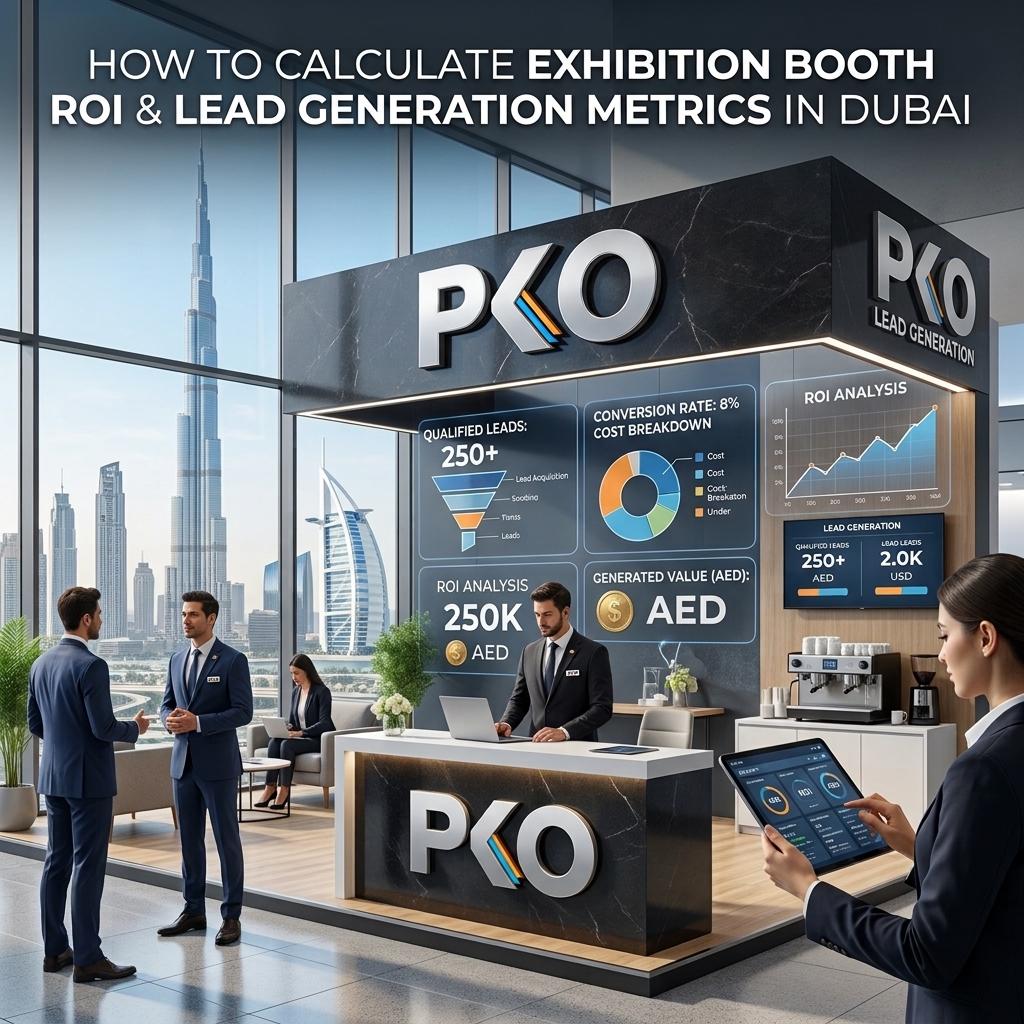
How to Calculate Exhibition Booth ROI & Lead Generation Metrics in Dubai
Most exhibitors leave a Dubai trade show knowing how many visitors stopped by their booth, but not how much revenue the stand actually produced. Footfall feels reassuring, but it does not tell you whether the exhibition paid for itself.
That is where an exhibition booth ROI calculator becomes useful. It turns booth attendance into a measurable business outcome: cost per lead, lead conversion rate, customer acquisition cost, and ultimately, return on investment. In a market like Dubai, where exhibitors invest heavily in stand space, design and staffing at venues such as Dubai World Trade Centre, tracking these numbers is what separates a marketing expense from a measurable revenue channel.
This guide breaks down exactly how to calculate exhibition booth ROI, the lead generation metrics that matter, and how to measure results after the event ends.
What Is Exhibition Booth ROI?
Exhibition booth ROI measures the financial return generated from an exhibition relative to what it cost to participate. It compares the revenue attributed to the event against total exhibition spend, expressed as a percentage.
Exhibition ROI formula:
\text{Exhibition ROI} = \frac{\text{Revenue Attributed to the Exhibition} – \text{Total Exhibition Cost}}{\text{Total Exhibition Cost}} \times 100
Each part of the formula matters:
- Revenue attributed to the exhibition is the closed sales value that can genuinely be traced back to leads or meetings that originated at the event.
- Total exhibition cost is every direct and indirect cost involved in exhibiting, not just the stand itself.
- The result is expressed as a percentage: a positive number means the exhibition generated more revenue than it cost; a negative number means it did not, at least within the period measured.
A useful exhibition booth ROI calculator is really just this formula applied consistently, event after event, using the same cost and revenue definitions each time.
What Costs Should You Include in Your Exhibition ROI Calculation?
Understating total exhibition cost is the most common reason ROI calculations look better than they really are. A complete figure should include:
- Exhibition stand or booth space rental, paid to the venue or organiser
- Stand design and construction, including any exhibition stand builder in Dubai or contractor fees
- Graphics, signage and printing for the stand
- Furniture, AV equipment and technology used on the stand
- Staff costs, including salaries, overtime or freelance staff for the days worked
- Travel and accommodation for staff and exhibiting team members
- Logistics, including freight, storage and on-site handling
- Promotional materials, giveaways and branded collateral
- Lead-generation tools, such as badge scanners or CRM integrations
- Pre-event and post-event marketing, including invitations, ads and follow-up campaigns
- Any permits, insurance or venue-required approvals
Leaving out staff time or pre-event marketing is common, but it distorts the real cost per lead. A realistic exhibition ROI calculation should reflect everything spent to get a lead from the show floor into your pipeline.
How to Calculate Exhibition Lead Generation Metrics
Exhibition lead generation metrics track how visitor interest moves through stages, from a booth conversation to a paying customer. The key metrics are:
- Total visitors: everyone who stopped at or engaged with the booth
- Leads captured: visitors whose contact details were recorded
- Qualified leads: leads that match your target customer profile or buying intent
- Marketing-qualified leads (MQLs): leads that show enough interest to enter a nurture sequence
- Sales-qualified leads (SQLs): leads ready for a direct sales conversation
- Meetings booked: follow-up meetings scheduled after the event
- Opportunities created: leads that have entered a formal sales pipeline with an estimated value
- Customers acquired: leads that closed as paying customers
- Revenue generated: total closed revenue from those customers
Raw visitor numbers alone tell you very little. A booth that attracts 2,000 visitors but produces 20 low-quality leads performs worse than a smaller stand that produces 80 qualified leads. Tracking the full funnel, from visitor to qualified lead to customer, is what makes exhibition lead generation metrics genuinely useful for measuring trade show ROI.
How to Calculate Cost Per Lead
Cost per lead tells you how much you spent, on average, to capture each lead at the exhibition.
Formula:
\text{Cost Per Lead} = \frac{\text{Total Exhibition Cost}}{\text{Number of Leads}}
This figure is easy to calculate but limited on its own, because it treats every lead as equally valuable. A better measure for commercial decision-making is cost per qualified lead, since it filters out contacts unlikely to convert.
Formula:
\text{Cost Per Qualified Lead} = \frac{\text{Total Exhibition Cost}}{\text{Qualified Leads}}
Simple illustrative example: if total exhibition cost is AED 100,000 and the event produced 250 leads, cost per lead is AED 400. If only 100 of those leads were qualified, cost per qualified lead rises to AED 1,000. Both numbers are useful, but cost per qualified lead is generally the more honest measure of how efficiently the exhibition generated commercially relevant contacts.
How to Calculate Exhibition Lead Conversion Rate
Exhibition lead conversion rate shows what proportion of leads actually turn into customers.
Formula:
\text{Lead Conversion Rate} = \frac{\text{Converted Leads}}{\text{Total Leads}} \times 100
This metric matters because it lets exhibitors compare performance across different Dubai and UAE exhibitions using one consistent yardstick, regardless of stand size, venue or industry vertical. An event that produces fewer leads but a higher conversion rate may deliver better exhibition marketing ROI than a larger event with weak follow-up. Tracking conversion rate over several events also shows whether changes to staffing, stand design or follow-up process are actually improving results.
How to Measure Revenue and ROI After the Exhibition
Most B2B sales cycles do not close on the show floor. Exhibition revenue attribution has to account for the gap between the event and the eventual sale, which can be weeks or months depending on the industry.
To measure this accurately, exhibitors should track:
- CRM tracking: every lead logged with source, date and event tag
- Follow-up timing: how quickly sales teams contact leads after the show
- Sales pipeline: how leads move through defined stages after the event
- Opportunity value: the estimated deal size attached to each opportunity
- Closed revenue: actual revenue booked from deals traced back to the exhibition
- Attribution window: an agreed period (commonly 3 to 12 months) within which a closed deal still counts as exhibition-driven
- Repeat customers: existing clients who re-engaged or expanded their order at the event
Without this post-event tracking, exhibition booth ROI is guesswork. A lead captured in March that closes in July still belongs to that exhibition’s ROI calculation, provided your CRM ties it back to the original source.
Simple Exhibition Booth ROI Calculator Example
The figures below are illustrative only, not actual PKO pricing or guaranteed results. They exist to show how the formulas work together.
Assumed inputs:
| Metric | Value |
| Total exhibition investment | AED 100,000 |
| Leads captured | 250 |
| Qualified leads | 100 |
| Customers acquired | 10 |
| Revenue attributed | AED 180,000 |
Calculations:
| Metric | Formula applied | Result |
| Cost per lead | 100,000 ÷ 250 | AED 400 |
| Cost per qualified lead | 100,000 ÷ 100 | AED 1,000 |
| Customer acquisition cost | 100,000 ÷ 10 | AED 10,000 |
| Exhibition ROI | (180,000 − 100,000) ÷ 100,000 × 100 | 80% |
In this illustrative scenario, the exhibition returned 80% on the investment, based purely on revenue attributed within the tracking period used. Applying the same structure consistently, using your own real cost and revenue figures, is what turns this into a genuine exhibition booth ROI calculator for your business.
Which Exhibition Metrics Should You Track in Dubai?
The table below summarises the core metrics worth tracking for any Dubai or wider UAE exhibition.
| Metric | Formula | Why it matters |
| Cost per lead | Total exhibition cost ÷ total leads | Shows raw lead acquisition efficiency |
| Cost per qualified lead | Total exhibition cost ÷ qualified leads | Filters out low-intent contacts |
| Lead conversion rate | Converted leads ÷ total leads × 100 | Compares performance across events |
| Meeting rate | Meetings booked ÷ total leads × 100 | Measures early sales engagement |
| Opportunity rate | Opportunities created ÷ qualified leads × 100 | Tracks pipeline quality |
| Customer acquisition cost | Total exhibition cost ÷ customers acquired | Shows true cost of a closed customer |
| Revenue per lead | Revenue attributed ÷ total leads | Indicates average lead value |
| Exhibition ROI | (Revenue − Cost) ÷ Cost × 100 | Final measure of financial return |
Tracking these consistently across every Dubai trade show gives exhibitors a comparable data set for deciding which events, formats and stand investments are worth repeating.
How Your Exhibition Stand Can Affect Lead Generation
The metrics above measure outcomes, but the stand itself influences how many of those outcomes happen. A few practical factors shape lead quality and volume on the day:
- Clear messaging: visitors decide in seconds whether to stop, so the value proposition needs to be visible from the aisle
- Visibility and sightlines: an open, uncluttered layout draws more foot traffic than a closed-off design
- Visitor flow: how people move through the space affects how many staff conversations actually happen
- Meeting areas: a defined space for private conversations helps qualify leads properly instead of rushing them
- Product demonstrations: hands-on interaction tends to produce higher-intent leads than passive browsing
- Lead capture setup: badge scanners or digital forms placed at natural stopping points reduce missed leads
- Branded graphics: consistent visual identity reinforces recall after the event, which supports later follow-up
- Staff positioning: staff placed to greet rather than block visitors tend to generate more qualified conversations
A well-planned layout does not guarantee a specific ROI, but it removes friction between visitor interest and lead capture. Exhibitors working with an experienced exhibition stand builder in Dubai often build these considerations into the design brief from the start, rather than adjusting the stand after a weak-performing event.
How to Improve Exhibition Booth ROI
- Define a measurable goal before booking the event (leads, meetings, or revenue).
- Set a specific lead target based on past performance or realistic expectations.
- Define in writing what qualifies as a good lead for your business.
- Track every lead source, including badge scans, business cards and manual entries.
- Train booth staff on qualification questions, not just greeting visitors.
- Use a consistent, timed follow-up process for every lead captured.
- Connect leads directly to your CRM with an event source tag.
- Compare results across events using the same metrics each time.
- Calculate final revenue only after the sales cycle has genuinely played out.
- Use the data to adjust the next stand, staffing plan or lead-capture process.
Exhibitors who treat exhibition booth ROI as an ongoing measurement process, rather than a one-off calculation, tend to make sharper decisions about which Dubai and UAE exhibitions are worth repeating.
FAQs
What is a good exhibition booth ROI?
There is no universal benchmark, since a good exhibition booth ROI depends on your margins, average customer value, sales cycle length and total exhibition cost. A high-value B2B exhibitor closing one large contract may see a very different ROI profile than a retail brand generating many small sales. Set your own target based on business objectives, then measure consistently against it.
How do you calculate exhibition booth ROI?
Subtract total exhibition cost from revenue attributed to the exhibition, then divide by total exhibition cost and multiply by 100. This gives a percentage return that reflects how much the event earned relative to what it cost to attend.
What is the average cost per exhibition lead?
Cost per lead varies widely by industry, event size and stand investment, so there is no fixed average. Calculate it for your own events using total exhibition cost divided by leads captured, then use it as a baseline to compare future exhibitions.
How do you calculate cost per qualified lead?
Divide total exhibition cost by the number of qualified leads, not total leads. This gives a more accurate picture of spend efficiency, since it excludes contacts unlikely to convert into paying customers.
Which exhibition metrics should exhibitors track?
At minimum, track total leads, qualified leads, cost per lead, cost per qualified lead, lead conversion rate, customer acquisition cost and exhibition ROI. Together these cover lead volume, lead quality, cost efficiency and final financial return.
How long should you track leads after an exhibition?
Most exhibitors use an attribution window of three to twelve months, depending on the typical sales cycle for their industry. Shorter windows suit fast-moving retail or consumer products; longer windows suit complex B2B sales.
How can exhibition stand design improve lead generation?
Clear messaging, open sightlines, defined meeting areas and well-positioned staff make it easier for visitors to engage and for staff to capture and qualify leads. Design does not guarantee a specific ROI, but it directly affects how many booth interactions turn into recorded leads.
Conclusion
Exhibiting in Dubai involves real investment, and visitor numbers alone will not tell you whether that investment paid off. Using an exhibition booth ROI calculator, built on clear cost tracking, qualified lead data and post-event revenue attribution, gives exhibitors an honest answer instead of a guess.
Once the measurement framework is in place, the stand itself becomes one of the levers you can adjust to improve results. For exhibitors planning their next stand with performance in mind, PKO Exhibitions & Events works across design, build and on-site execution for exhibitions throughout Dubai and the wider UAE. If you are preparing for an upcoming show, get in touch to discuss a stand built around your lead generation goals.