
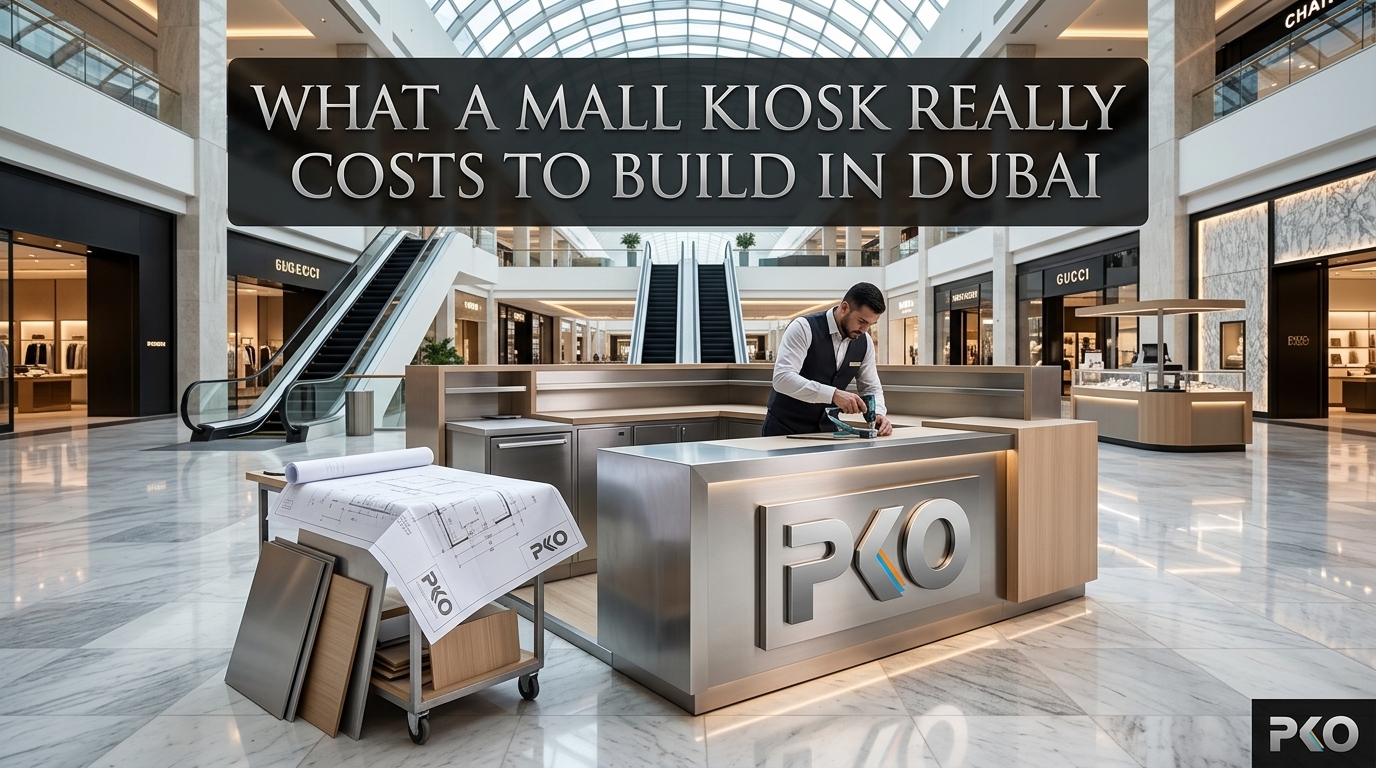
Ask three suppliers to quote the same retail unit and you will often get three very different numbers. That is rarely about one company overcharging. It happens because a kiosk is a custom-built structure, and the mall kiosk cost in Dubai shifts with size, design complexity, materials, branding, technology and the conditions the mall sets for installation. A compact accessories counter and a two-sided coffee kiosk with plumbing, screens and illuminated branding are not the same product, even if both occupy a similar footprint.
There is no single fixed price. What follows is a practical look at where the money actually goes, so you can read a quotation properly and set a budget that survives contact with the drawings.
How Much Does a Mall Kiosk Cost in Dubai?
As a build-only figure covering design, fabrication, finishes, signage and installation, most mall kiosks in Dubai fall somewhere between roughly AED 20,000 and AED 150,000. This excludes mall rent, trade licensing, stock and staffing, which are separate business costs.
Broadly, projects tend to group into three tiers:
- Entry level, around AED 20,000 to AED 40,000. Typically 4 to 6 square metres, MDF carcass with laminate finish, printed graphics, LED strip lighting, simple counters and shelving.
- Mid range, around AED 45,000 to AED 90,000. Usually 6 to 10 square metres with mixed materials, acrylic or solid surface countertops, illuminated 3D lettering, a considered lighting layout, lockable storage and one or two screens.
- Premium, from around AED 100,000 upward. Ten square metres and above, using glass, powder-coated metal or aluminium framing, veneer or solid surface, bespoke joinery, digital displays and equipment such as refrigeration or extraction.
Treat these as indicative planning ranges rather than quoted prices. The number only becomes real once the layout, material schedule and the specific mall specification are agreed, because two kiosks of identical size can differ by a factor of three depending on what they are made from and what they need to do.
What Factors Affect Mall Kiosk Costs in Dubai?
Every quotation is built from the same set of variables. Understanding them makes it much easier to compare suppliers fairly.
Kiosk Size and Floor Space
Size is the starting point, though cost does not scale in a straight line. A larger footprint means more structure, more surface area to finish and more material, but it also allows simpler construction. A tightly packed 4 square metre unit that has to hold stock, a till point and a display wall can cost more per square metre than a roomier one.
Custom Design Requirements
A rectangular kiosk built from standard panel sizes is efficient to produce. Curves, arches, angled facades, floating canopies and multi-level counters all require additional templating, cutting and hand finishing. Custom kiosk design is usually where a budget quietly expands, because each unusual shape adds workshop hours rather than material cost alone.
Materials and Finishes
Material choice can double a budget without changing the design at all. Laminate over MDF is the practical baseline. Solid surface, real veneer, tempered glass, stainless steel and stone-effect tops sit well above it, and they also demand more precise fabrication and careful handling on site.
Fabrication and Manufacturing
Fabrication is the largest line item in most kiosk projects. It covers the frame, joinery, edge work, spraying, assembly and quality checks before the unit ever leaves the workshop. Producing structures in house, as PKO does through its custom kiosk and display manufacturing facility, keeps tolerances tight and avoids the cost creep that comes from splitting a build across several subcontractors.
Signage and Branding
Signage carries a large share of the visual impact and a meaningful share of the cost. Flat vinyl lettering is inexpensive. Fabricated acrylic letters, halo-lit branding, light boxes and neon-style elements involve fabrication, wiring and drivers, so budgets for LED and illuminated signage should be set early rather than added once the structure is already built.
Lighting and Electrical Requirements
Malls specify electrical loads, cable routing and testing standards, and the kiosk must be wired to meet them. Spotlights, dimmable strips, transformers, distribution boards and socket points all add up. Poorly planned lighting is also the most common reason a finished kiosk looks cheaper than the render suggested.
Digital Screens and Interactive Features
Screens, touch panels, media players, mounting brackets and ventilation add both hardware and integration cost. They also introduce ongoing responsibilities such as content updates and servicing, which is worth factoring in before committing to a video wall that a single well-lit display could replace.
Printing and Graphics
Printed panels, backlit films, vinyl wraps and product visuals are a cost-effective way to change the look of a kiosk without rebuilding it. Quality matters here, since a low-resolution or poorly laminated print is visible from a metre away. Working with a supplier that handles large-format printing and branding graphics in house usually gives better colour consistency across signage, panels and promotional material.
Installation and Mall Requirements
Most Dubai malls require installation outside trading hours, which means night work, access permits, protective flooring, trained crews and supervision. Drawings normally need approval before any work begins, and revisions requested by the mall can affect materials, height limits or lighting. This is a genuine cost line, not an afterthought.
Transportation and Logistics
The kiosk has to travel from the workshop to the mall in sections, be moved through service corridors and lifts, and be assembled in place. Oversized panels, heavy stone tops and glass elements raise handling costs and sometimes force design changes so the unit can physically reach its location.
Typical Cost Breakdown for a Mall Kiosk
The proportions below reflect how budgets are usually distributed on a custom retail kiosk. They are approximate and shift with the specification.
| Budget Area | Typical Share | Notes |
|---|---|---|
| Design and 3D visualisation | 5% to 10% | Concept, drawings, revisions |
| Structure, fabrication and joinery | 40% to 50% | The largest single cost |
| Finishes and material upgrades | 10% to 20% | Rises fast with premium surfaces |
| Signage and branding elements | 8% to 15% | Illuminated signs cost more |
| Lighting and electrical work | 5% to 12% | Depends on load and fixtures |
| Printing and graphics | 3% to 8% | Vinyl, panels, backlit prints |
| Transport and installation | 8% to 15% | Night shifts increase this |
If a quotation gives you only a single total with no visibility into these areas, ask for it to be itemised. It is the fastest way to see whether a low price reflects efficiency or missing scope.
How Kiosk Design Affects the Final Price
Design decisions influence cost long before fabrication starts. A few patterns come up repeatedly:
- Simple geometry with clean detailing usually looks more expensive than it is. Complex shapes often look cheaper than they cost, because the effort is hidden inside the structure.
- Storage is frequently underestimated. Retail staff need somewhere to keep stock, bags and packaging, and adding concealed storage late means reworking counters that are already built.
- Display units and counter height drive both material use and customer experience. Getting the ergonomics right in the drawing stage costs nothing. Fixing it afterwards costs a rebuild.
- Lighting can lift a mid-range build considerably. A modest kiosk with well-positioned lighting and a strong illuminated sign will outperform a costlier one that is flatly lit.
- Technology should earn its place. A screen that displays a static logo is an expensive poster.
This is why the design phase deserves real attention. An experienced design team will resolve the layout, sightlines, branding zones and service access on paper, where changes are still free.
Choosing Materials for a Mall Kiosk
Material selection is the most direct lever you have over both quality and budget.
Wood and MDF. The standard carcass material for kiosks. Cost-effective, easy to shape and reliable when properly sealed and edged. Quality depends heavily on the finish applied to it.
Laminate finishes. A practical way to achieve wood, stone or solid colour looks at a controlled price. Durable and easy to replace, though edges and joints reveal the workmanship.
Acrylic. Widely used for lettering, display shelves, light diffusion and product holders. Lightweight, easy to illuminate and comparatively affordable, but it scratches and needs regular cleaning in a busy mall.
Glass. Excellent for product visibility and a premium impression. Tempered glass, correct fixings and safe handling raise both cost and installation complexity.
Metal and aluminium. Used for framing, structural support and detailing. Strong, long lasting and well suited to larger or reusable kiosks. Powder coating and welding add to the price but also to lifespan.
Custom finishes. Solid surface, veneer, mirror finishes, terrazzo effects and textured panels all deliver a distinctive look. They are the right choice for flagship units, and they should be specified with the maintenance reality of a mall environment in mind.
Additional Costs Businesses Should Plan For
Manufacturing is only part of the picture. Budget for these as well:
- Mall approvals and permits. Drawing submissions, fit-out permits and security deposits vary by mall and can take weeks.
- Design modifications. Changes requested by mall management after review are common and can affect height, materials or electrical layout.
- Signage and printed graphics. Often quoted separately from the structure.
- Electrical connection and testing. Including any certification the mall requires.
- Transport and night-shift installation. Access windows are usually narrow and supervised.
- Maintenance and refresh. Graphics fade, laminate edges chip and lamps fail. Setting aside a small annual allowance keeps the unit looking new.
- Storage or relocation. Relevant for seasonal or promotional kiosks that move between locations.
How to Control Your Mall Kiosk Budget
Cost control on a kiosk project comes from clarity, not from cutting corners.
- Start with a written brief. Size, products, staff numbers, storage needs, power requirements and the mall location. Suppliers price uncertainty, so a vague brief produces a padded quote.
- Define the purpose. A sales kiosk, a sampling stand and a service counter have different requirements. Building for all three at once wastes money.
- Prioritise what customers actually notice. The counter face, the signage, the lighting and the product display. Spend there first.
- Choose practical materials for high-contact surfaces and save premium finishes for feature areas.
- Avoid complexity that adds no commercial value. Every curve and floating element has a workshop cost attached.
- Lock branding early. Late logo, colour or artwork changes mean reprinting and sometimes refabrication.
- Ask for one supplier to handle design, fabrication, signage and installation. Coordination gaps between vendors are expensive and hard to recover.
- Plan for modification. If you expect to update seasonally, design replaceable graphic panels instead of permanently applied finishes.
Why Professional Kiosk Manufacturing Matters
A mall kiosk sits in a high-traffic public space for months or years, handled by staff and customers every day. That environment exposes weak construction quickly. Edges lift, doors sag, lighting fails and finishes discolour, and each repair happens in front of shoppers.
Experienced manufacturers plan for that. They specify the right substrate for humidity and cleaning routines, build access panels where technicians will need them, wire to the standards mall management inspects, and test-assemble the unit in the workshop before delivery so installation night runs to schedule. They also understand the approval process well enough to avoid submissions being returned.
The result is not simply a better-looking kiosk. It is a lower total cost over the life of the unit, which is the figure that matters once the initial invoice is settled.
Frequently Asked Questions
How much does a mall kiosk cost in Dubai?
Most build-only budgets land between roughly AED 20,000 and AED 150,000. Simple laminate units sit at the lower end, while larger kiosks using glass, metal, premium finishes and digital displays sit well above it. Mall rent, licensing and stock are separate costs.
What is included in the cost of building a kiosk?
A complete kiosk quotation normally covers design and 3D visuals, structural fabrication, joinery and finishes, signage, lighting and electrical work, printed graphics, transport and on-site installation. Confirm which of these are included before comparing prices.
What makes a mall kiosk more expensive?
The main drivers are premium materials such as glass, solid surface and metal, complex or curved geometry, illuminated and fabricated signage, digital screens, plumbing or refrigeration, and demanding mall installation conditions.
How long does it take to build a mall kiosk?
A straightforward kiosk typically takes around two to four weeks from approved design to installation. Larger custom units with specialist finishes or equipment commonly take four to eight weeks. Mall approval timelines should be added on top.
What materials are best for mall kiosks?
MDF with a quality laminate finish offers the best balance of cost and durability for most units. Acrylic suits displays and lettering, glass works well for product visibility, and metal or aluminium framing is worth the investment for larger kiosks or units that will be relocated.
Can a kiosk be customised for different products?
Yes. Shelving heights, counter depth, storage, display fixtures and graphics can all be tailored to the product category. If you plan to change products seasonally, ask for modular shelving and replaceable graphic panels at the design stage.
Do mall approvals affect kiosk costs?
They can. Malls set requirements for height, materials, electrical work and installation hours, and revisions requested during approval may change the specification. Building approval time and a small contingency into the plan avoids rushed and costlier changes later.
Final Thoughts
There is no standard price for a retail kiosk, and any supplier who quotes one before seeing your requirements is guessing. The mall kiosk cost in Dubai depends on size, design complexity, materials, signage, lighting, technology and the installation conditions of the specific mall. Once those are defined, the budget becomes predictable and much easier to protect.
If you are planning a kiosk and want a realistic cost picture based on your actual layout and specification, get in touch with the PKO Exhibitions and Events team to discuss design, fabrication, signage and installation for your project.