
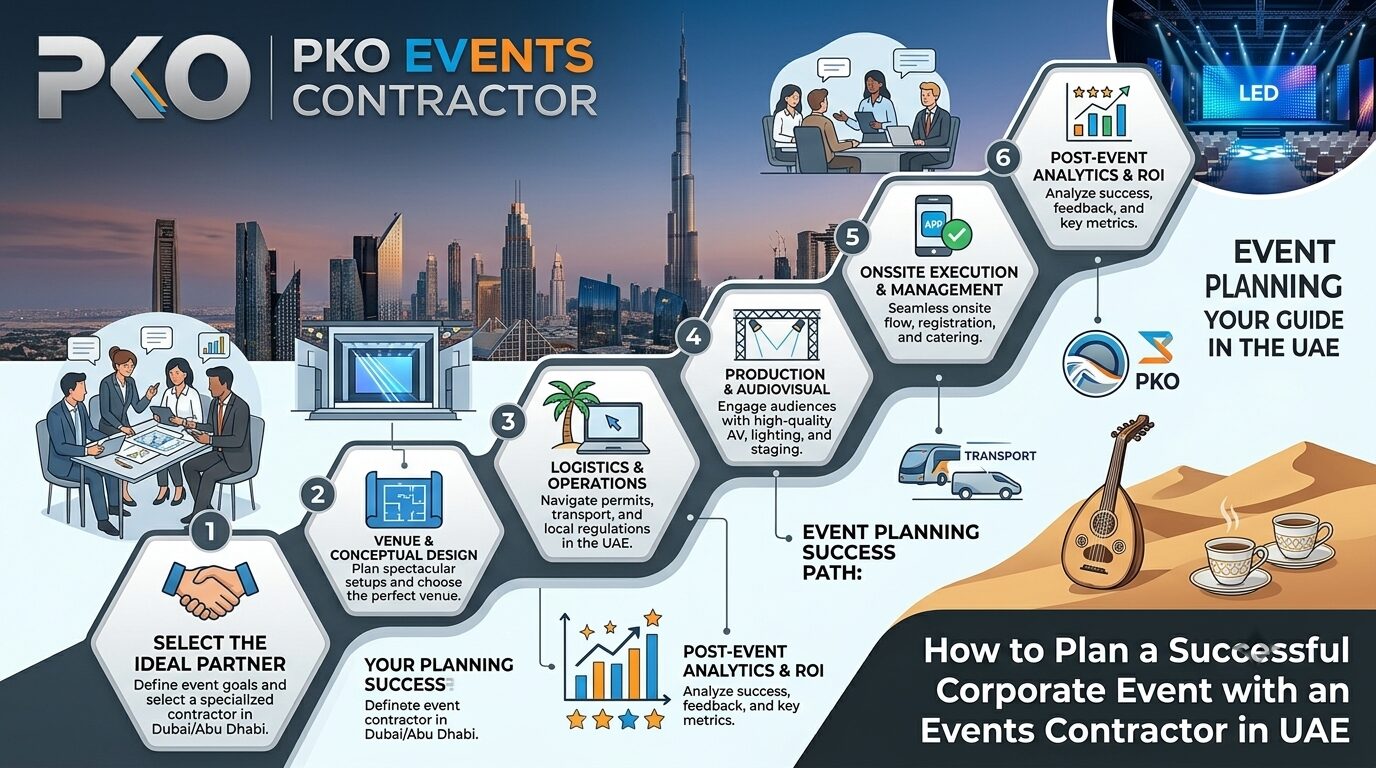
How to Plan a Successful Corporate Event with an Events Contractor in UAE
Planning a corporate event in the UAE involves much more than selecting a venue and sending invitations. A successful event needs a clear business objective, the right audience strategy, suitable venue, professional production, effective branding, reliable logistics, and coordinated execution. Whether the occasion is a conference, product launch, networking event, seminar, annual gathering, or corporate showcase, every element should work toward a defined outcome.
Working with an Events Contractor in UAE can help businesses bring these elements together through a structured planning and execution process. From developing the event brief and coordinating suppliers to managing stage production, event branding, guest flow, technical requirements, and on-site operations, the contractor can help turn the initial concept into a practical event experience.
The key is to begin with the purpose of the event rather than the physical setup. Once the objective, audience, budget, venue, and expected results are established, decisions about design, production, exhibition displays, staffing, and logistics become much easier to coordinate. This guide explains how businesses can plan a successful corporate event in the UAE, what to expect from a Corporate Events Contractor in UAE, and how to manage each stage from the initial brief through post-event evaluation.
Define the Corporate Event Objective Before Hiring a Contractor
Before choosing an event format, venue, or production setup, define exactly what the corporate event is expected to achieve. A clear objective gives the planning team a practical direction and helps an Events Contractor in UAE understand what the event needs to accomplish beyond simply attracting attendees.
Corporate events can serve different purposes. A company may organize a product launch to introduce a new offering, a conference to share industry knowledge, a networking event to develop business relationships, or an annual gathering to bring employees and stakeholders together. Other events may focus on generating qualified leads, strengthening client relationships, recognizing employee achievements, or creating opportunities for demonstrations and product showcases.
A useful planning sequence is:
Objective → Audience → Desired Action → Event Format → Success Metric
For example, if the objective is lead generation, the event may need dedicated networking areas, product demonstrations, branded displays, meeting spaces, and an organized process for capturing visitor information. If the objective is executive networking, the focus may shift toward guest experience, seating arrangements, hospitality, discussion areas, and controlled interaction between attendees.
The objective should also be measurable. Depending on the type of event, useful indicators may include registration numbers, attendance rate, qualified leads, meetings generated, attendee engagement, client participation, feedback scores, or post-event enquiries. Establishing these measures before the event makes it easier to determine whether the investment produced the intended business result.
This initial clarity also helps prevent unnecessary spending. Instead of adding design features or production elements simply because they are available, the planning team can prioritize the elements that contribute directly to the event’s purpose. An Event Management Contractor in UAE can then align suppliers, production requirements, branding, staffing, and logistics around those priorities.
Once the business objective and expected outcome are clear, the next step is understanding who the event is being designed for. The audience profile will influence the event format, venue requirements, guest journey, seating, hospitality, and overall experience.
Understand the UAE Corporate Event Audience and Its Requirements
Once the purpose of a corporate event is defined, the next planning decision is to understand the audience. The same venue, seating arrangement, communication style, and event experience will not work equally well for every group. An event designed for senior executives, for example, may require a different environment from an employee gathering, product demonstration, or industry networking event.
Corporate events in the UAE may bring together local businesses, international companies, senior executives, employees, clients, partners, investors, speakers, exhibitors, and other stakeholders. Each group can have different expectations regarding communication, accessibility, hospitality, networking, and event flow. Defining these expectations early helps the planning team build an experience that feels organized rather than generic.
An Events Contractor in UAE should understand the expected attendee profile before finalizing the physical and operational requirements. Audience characteristics can influence several important decisions, including:
- Guest capacity: Estimate expected attendance and allow suitable space for movement, seating, networking, and service areas.
- Seating arrangement: Select theatre, classroom, banquet, boardroom, lounge, or mixed seating according to the program.
- Registration: Determine whether standard registration desks, digital check-in, VIP reception, or multiple registration points are needed.
- Guest movement: Plan clear routes between entrances, registration, seating, stages, catering areas, networking zones, and exits.
- VIP requirements: Consider dedicated reception, seating, hospitality, access, and coordination for senior guests where appropriate.
- Networking: Create practical areas where clients, partners, employees, or industry professionals can interact comfortably.
- Accessibility: Make sure entrances, seating, circulation routes, and facilities are suitable for the expected audience.
- Communication: Consider the languages, presentation formats, signage, and information requirements relevant to attendees.
Audience size also needs to be distinguished from audience type. A smaller executive event may require more controlled movement and personalized hospitality, while a larger conference may place greater emphasis on registration capacity, directional signage, session transitions, and crowd flow. Similarly, an event containing a product showcase may require additional demonstration or exhibition areas.
Understanding these requirements allows the Corporate Events Contractor in UAE to translate the audience profile into practical planning decisions. Instead of treating guest experience as something added at the end, the contractor can incorporate it into the venue layout, production plan, branding, staffing, and logistics from the beginning.
With the audience clearly defined, the planning process can now move toward selecting an event format and venue that can accommodate the purpose, guest profile, program, and operational requirements.
Select the Right Event Format and Venue
After defining the event objective and understanding the audience, the next step is to choose an event format and venue that can support both. The venue should not be selected simply because it looks impressive or has enough seats. Its layout, facilities, accessibility, technical capabilities, and operational restrictions should match the actual requirements of the corporate event.
Depending on the purpose and audience, a company may consider a hotel ballroom, conference venue, exhibition centre, business facility, outdoor location, or dedicated event space. Each option can offer different advantages, so the decision should be based on the program rather than appearance alone.
An Events Contractor in UAE can help assess whether the selected venue is practical for the proposed event setup. Key considerations include:
- Capacity: Confirm that the venue can accommodate guests comfortably while allowing enough space for stages, production equipment, catering, networking, and circulation.
- Accessibility: Consider proximity, parking, public transportation, entrances, and accessibility requirements for attendees.
- Registration area: Ensure there is sufficient space for check-in desks, guest queues, badges, welcome staff, and information points.
- Stage and presentation space: Check whether the room can accommodate the required stage, backdrop, screens, speakers, podium, and audience sightlines.
- Audio-visual requirements: Review available power, internet connectivity, technical infrastructure, screen placement, lighting positions, and equipment access.
- Catering facilities: Confirm whether the venue can support the required meal or refreshment format and whether service areas interfere with guest movement.
- Loading and unloading: Check delivery routes, loading bays, freight access, storage areas, and restrictions for event equipment.
- Setup and dismantling: Establish exactly how much time suppliers have before and after the event to install and remove equipment, branding, furniture, and production elements.
- Emergency and safety access: Make sure event layouts do not interfere with designated emergency routes or other venue requirements.
A site inspection is particularly valuable before finalizing the production plan. During the inspection, the contractor and relevant suppliers can review dimensions, access points, ceiling height, power locations, stage positioning, guest circulation, branding opportunities, and technical limitations. This can identify practical issues before they become costly changes during installation.
The event format should also influence the venue layout. A conference may need a presentation-focused arrangement with clear stage visibility, while a networking event may require more open circulation and lounge areas. A corporate event that includes a product demonstration or showcase may additionally need branded display areas or an exhibition zone.
Choosing the right venue therefore creates the physical framework for everything that follows. Once the location and format are confirmed, the business can prepare a detailed event brief that gives the Event Management Contractor in UAE a clear understanding of the scope, deliverables, timeline, and expected outcome.
Create a Detailed Event Brief for Your Contractor
Once the event objective, audience, and venue have been established, the next step is to create a detailed event brief. This document gives the Events Contractor in UAE a clear understanding of what needs to be delivered, when it needs to happen, and how success will be measured.
A well-prepared brief reduces misunderstandings between the client, contractor, venue, and suppliers. It also makes it easier to identify missing requirements, estimate costs, allocate responsibilities, and build a realistic production schedule before work begins.
A corporate event brief should normally include the following:
| Event brief element | What to define |
| Event objective | The business purpose and intended outcome |
| Date and timing | Event date, operating hours, setup and dismantling windows |
| Venue | Location, room, available facilities, access restrictions, and site requirements |
| Audience | Guest profile, expected attendance, VIP requirements, and accessibility considerations |
| Program | Sessions, speeches, presentations, networking, entertainment, demonstrations, or other activities |
| Branding | Corporate identity, event messaging, signage, stage visuals, and branded areas |
| Production | Stage, LED screens, audio, lighting, presentation equipment, and technical support |
| Catering | Refreshments, meals, service format, dietary requirements, and hospitality |
| Staffing | Registration, ushers, event coordinators, technical staff, and other support personnel |
| Budget | Approved spending range, priority areas, and contingency allowance |
| Timeline | Design approvals, supplier deadlines, site inspection, installation, rehearsal, and event-day milestones |
| KPIs | Attendance, engagement, leads, meetings, feedback, or other measurable outcomes |
The brief should be specific enough to distinguish between essential requirements and optional additions. For example, if the event includes a product showcase, the brief should state whether the business needs a simple display area, several branded demonstration points, or a complete exhibition environment. This distinction can affect design, fabrication, floor space, power, graphics, installation, and staffing requirements.
It is also important to define who is responsible for each deliverable. Venue-related services, catering, technical production, event branding, furniture, exhibition displays, photography, registration, and other services may involve different suppliers. A clear responsibility matrix can prevent two suppliers from assuming the other is handling the same task or worse, leaving a requirement uncovered.
The event brief should then become the reference point for proposals and project discussions. When the scope is documented properly, the contractor can prepare a more accurate plan and identify potential operational challenges early.
A detailed brief also provides the foundation for budgeting. Once the required services, production elements, staffing, and logistics are known, the business can establish a realistic event budget rather than making financial decisions based on incomplete information.
Build a Realistic Corporate Event Budget
A clear event brief makes it easier to establish a realistic budget. Corporate event costs can vary considerably depending on the venue, number of attendees, production requirements, branding, catering, staffing, logistics, and level of customization. Instead of focusing only on the headline quotation, businesses should understand what is included in the overall event scope and where additional costs may arise.
A practical corporate event budget can be divided into several categories:
- Venue: Rental charges, room requirements, access, and additional venue services.
- Event production: Stage, set elements, LED screens, audio systems, lighting, and technical equipment.
- Branding and signage: Stage graphics, entrance branding, directional signage, registration branding, and other visual elements.
- Furniture: Seating, tables, lounge furniture, registration counters, and networking setups.
- Catering: Food, beverages, service staff, refreshments, and special dietary requirements.
- Staffing: Event coordinators, registration staff, ushers, technical personnel, and other operational support.
- Logistics: Transportation, deliveries, storage, installation, dismantling, and equipment movement.
- Photography and videography: Event documentation, presentations, interviews, or promotional content where required.
- Exhibition or display requirements: Product displays, branded demonstration areas, exhibition graphics, or custom booth structures when relevant.
- Contingency: A reasonable reserve for unexpected requirements, schedule changes, additional technical needs, or other unforeseen costs.
The important distinction is between an estimated budget and a controlled event budget. An initial estimate helps determine feasibility, while supplier quotations and confirmed requirements create a more accurate financial picture. As planning progresses, approved costs should be tracked against the original allocation so that changes are identified before they affect the final spend.
When reviewing a contractor’s proposal, businesses should also check what each price includes and excludes. Items such as transportation, overtime, installation, dismantling, additional equipment, venue charges, artwork revisions, or last-minute changes can affect the final cost if they were not clearly addressed in the original scope.
The lowest quotation is therefore not automatically the most cost-effective option. A lower price may reflect fewer services, simpler materials, limited technical support, or exclusions that later become additional expenses. A more useful comparison is to assess scope, quality, reliability, delivery capability, and total expected cost together.
An Events Contractor in UAE should be able to explain how the proposed budget connects with the event objectives and identify where spending will have the greatest impact. For instance, a product launch may benefit more from strong presentation technology and product-display areas than from unnecessary decorative elements, while an executive networking event may place greater value on hospitality, guest flow, and comfortable interaction spaces.
Once the budget and scope are aligned, the next step is to evaluate contractors based on their ability to deliver those requirements not simply on the price stated in the quotation.
Choose an Events Contractor in UAE Based on Capability, Not Just Price
Selecting the right Events Contractor in UAE is an important decision because the contractor may be responsible for coordinating multiple elements of the event at the same time. A professional appearance in a portfolio is useful, but it should not be the only factor considered. Businesses should assess whether the contractor has the experience, resources, project-management process, technical understanding, and communication structure required for the specific event.
Look for Relevant Corporate Event Experience
Start by reviewing experience with events similar to yours. A contractor that regularly handles conferences may have a different operational approach from one specializing in product launches, networking events, corporate celebrations, or exhibition-led events.
Look for evidence of experience with comparable:
- Event size
- Guest numbers
- Venue types
- Production requirements
- Branding requirements
- Event formats
- Installation and dismantling schedules
Relevant experience helps the contractor anticipate practical requirements before they become problems during event execution.
Evaluate Production and Technical Capabilities
Corporate events often involve several technical and physical components that need to work together. Depending on the event, the contractor may need to coordinate:
- Stage and set production
- LED screens and presentation displays
- Audio systems and microphones
- Event lighting
- Furniture and guest areas
- Signage and event branding
- Registration setups
- Product or exhibition displays
- Installation and dismantling
The key question is not simply whether a contractor offers these services, but whether it can coordinate them as part of one coherent production plan.
Review Project Management Processes
Good event execution depends heavily on coordination. Ask how the contractor manages the project from the initial brief through event day.
A structured process may include:
Brief → Proposal → Concept → Approval → Production → Site Inspection → Installation → Rehearsal → Event Execution → Dismantling
Businesses should know who their main project contact will be, how approvals are handled, how changes are documented, and how suppliers and venue requirements are coordinated.
Examine the Portfolio for Relevant Work
A portfolio can demonstrate the contractor’s ability to deliver different event environments, but it should be reviewed carefully. Look for projects that show practical execution rather than focusing only on attractive photographs.
For corporate events, consider whether previous work demonstrates:
- Professional stage environments
- Consistent corporate branding
- Effective guest layouts
- Quality production
- Well-organized exhibition or display areas
- Appropriate use of lighting and visual elements
- Clean installation and finishing
If the event includes a trade-show or exhibition component, it may also be useful to assess experience as an Exhibition Stand Builder in Dubai, particularly where stand design, fabrication, graphics, installation, and event-day coordination need to work alongside the wider corporate event.
Check Communication and Documentation
Clear communication is especially important when several suppliers, venue representatives, speakers, and internal stakeholders are involved. A contractor should be able to provide understandable documentation covering the scope, schedule, deliverables, responsibilities, and costs.
Before appointment, clarify:
- Who manages the project
- What services are included
- Which services are handled by third parties
- Approval deadlines
- Revision procedures
- Installation dates
- Event-day responsibilities
- Dismantling arrangements
- Contingency procedures
Compare Overall Value
The right contractor should be assessed on overall value rather than price alone. A slightly higher quotation may be justified when it includes stronger project management, better technical coordination, reliable installation, clearer documentation, or a more complete scope.
The objective is to appoint a contractor capable of delivering the event requirements within the agreed budget, timeline, quality expectations, and operational constraints.
Once the contractor is selected, the planning process can move from basic logistics into the creative environment of the event. This includes deciding how the company should be represented visually through stage design, branding, signage, displays, and other physical touchpoints.
Plan Event Branding, Stage Design and Corporate Visuals
Once the contractor has been selected, the next step is to translate the company’s identity and event objective into a consistent physical environment. Corporate event branding should do more than place a logo around the venue. It should help attendees understand where they are, what the event represents, and how the different areas of the venue connect.
The design approach should be based on the event’s purpose, audience, venue, and corporate identity. A product launch may require prominent product visuals and demonstration areas, while a conference may prioritize a professional stage backdrop, presentation screens, speaker visibility, and clear directional signage.
An Events Contractor in UAE can coordinate the different branded elements so that they work together rather than appearing as separate additions. Depending on the event, these may include:
- Stage backdrop: A central visual element that supports presentations, speeches, and photography.
- Entrance branding: Creates a clear first impression and establishes the event identity as guests arrive.
- Registration branding: Helps connect the check-in area with the overall event theme and corporate identity.
- Directional signage: Guides attendees between entrances, sessions, catering areas, networking spaces, and other facilities.
- Presentation visuals: Ensures slides, screens, backdrops, and stage elements maintain a consistent visual identity.
- Sponsor branding: Provides appropriate visibility for sponsors without competing with the primary corporate message.
- Networking areas: Can incorporate subtle branding through furniture layouts, graphics, displays, and signage.
- Photo opportunities: A branded backdrop or dedicated visual area can create a natural location for event photography.
- Product displays: Where relevant, products can be incorporated into demonstration or showcase zones.
The physical environment should also be considered from the attendee’s perspective. Branding should remain visible from relevant viewing angles without obstructing presentations, guest movement, emergency access, or technical equipment. The scale, placement, lighting, materials, and finish of each element should therefore be considered during the design stage.
Integrating Exhibition Design Where It Makes Sense
Some corporate events include a product showcase, sponsor area, trade-show component, or dedicated exhibition zone. In these cases, exhibition design can become an extension of the wider event environment.
Businesses may require support from an Exhibition Stand Design Company Dubai for elements such as a custom exhibition booth, product display, branded demonstration area, or trade show stand. Depending on the scope, this can involve Custom Exhibition Stand Design Dubai, Exhibition Display Design Dubai, Creative Exhibition Stand Design, or 3D Exhibition Stand Design Dubai.
The important point is to keep exhibition elements connected to the overall event objective. A stand or display should have a clear function, such as presenting a product, encouraging conversations, demonstrating a service, collecting qualified leads, or creating a structured meeting point.
For larger showcase areas, the design process may progress through concept development → 3D visualization → material selection → fabrication → graphics → installation. This creates a clear connection between creative planning and physical execution.
When branding, stage design, and exhibition displays are planned together, the result is more cohesive and easier for attendees to navigate. It also allows the contractor to coordinate dimensions, graphics, technical requirements, installation schedules, and venue restrictions before production begins.
With the visual environment established, the next stage is to determine whether the corporate event requires a dedicated exhibition stand or showcase area and how that component should be integrated into the wider event plan.
Integrate Exhibition Stands When the Corporate Event Includes a Showcase
Not every corporate event needs an exhibition stand. However, when a conference, product launch, networking event, or corporate gathering includes a product showcase, sponsor area, demonstration zone, or trade-show component, an exhibition stand can provide a structured space for engagement.
In these situations, the exhibition area should be planned as part of the wider event rather than treated as a separate project. Its size, position, design, branding, visitor flow, technical requirements, and installation schedule should all support the main event objective.
Depending on the scope, businesses may work with an Exhibition Stand Builder in Dubai, Exhibition Stand Contractors Dubai, Exhibition Stand Companies in Dubai, or Exhibition Stand Designers in Dubai. For projects requiring physical production, an Exhibition Stand Fabricators in Dubai can translate the approved concept into a finished structure, while Exhibition Booth Contractors in Dubai can coordinate construction and installation requirements.
Match the Stand Design With the Event Objective
The first question should be what the exhibition space needs to achieve. A product demonstration may require open viewing areas and integrated screens, while a lead-generation stand may need reception counters, meeting tables, product displays, and areas for private conversations.
The design should consider:
- Visitor access and circulation
- Brand visibility
- Product or service presentation
- Demonstration areas
- Meeting spaces
- Storage requirements
- Reception or lead-capture points
- Screens and presentation equipment
- Lighting
- Exhibition graphics
- Signage
- Power and connectivity
Follow a Structured Stand Design and Build Process
A professional exhibition component generally follows a defined workflow:
Event brief → Concept → 3D design → Approval → Fabrication → Graphics → Installation → Inspection → Event operation → Dismantling
The concept stage establishes the overall visual direction. A Custom Exhibition Stand Design Dubai approach may be appropriate when the business needs a distinctive environment built around its brand, products, or visitor journey. For projects where flexibility, reuse, or efficient installation is important, Modular Exhibition Stand Designers Dubai may provide another suitable approach.
The 3D design stage is particularly useful because it allows the client to review the proposed layout, branding, display areas, meeting spaces, and visitor flow before fabrication begins. This can help identify practical changes before materials are ordered or construction starts.
Coordinate Fabrication and Installation With the Event
Exhibition stand production does not end with design approval. The physical structure needs to arrive at the venue at the correct time, be installed according to venue rules, and be ready before attendees enter the event.
This is where Exhibition Stand Fabrication Dubai and Exhibition Booth Construction Dubai become connected to wider event project management. The contractor may need to coordinate delivery schedules, loading access, installation teams, electrical requirements, graphics, furniture, technical equipment, and final inspection.
For businesses participating in a larger trade-show environment, services such as Trade Show Booth Design Dubai, Exhibition Booth Design and Build Dubai, and Exhibition Stand Design for Trade Shows can be integrated into the overall event strategy.
The same principle applies whether the project involves a large custom stand, a modular exhibition stand, or a smaller branded display: the exhibition component should serve a defined business purpose and fit naturally into the overall attendee journey.
Once the exhibition or showcase area is planned, attention should turn to the technical production that supports the main corporate event, including audio, visual displays, lighting, presentations, and stage requirements.
Coordinate AV, Lighting, Stage and Presentation Requirements
Technical production is one of the areas where detailed planning can make a major difference to the quality of a corporate event. A well-designed stage or venue can still underperform if the audio is unclear, presentation screens are poorly positioned, lighting is unsuitable, or speakers do not have the equipment they need. These requirements should therefore be defined early and coordinated with the venue and event team.
An Events Contractor in UAE should assess the event program and determine which technical elements are required for each part of the schedule. A typical corporate event may need:
- LED screens or projection systems
- Presentation screens and confidence monitors
- Microphones for speakers and panel discussions
- Professional speakers and audio systems
- Stage lighting
- Ambient or architectural lighting
- Podiums and lecterns
- Presentation clickers
- Video playback systems
- Recording or live-streaming equipment
- Technical control and operator support
Match AV Requirements to the Program
The technical setup should reflect how the space will actually be used. A keynote presentation may require a large screen and clear speaker audio, while a panel discussion may require multiple microphones, comfortable stage positioning, and appropriate lighting for each participant.
If the event includes product demonstrations, videos, presentations, or live content, the technical team should confirm file formats, connection requirements, playback systems, screen ratios, and backup arrangements before event day.
Plan Lighting Around Both Function and Visual Impact
Lighting has two roles at a corporate event: helping people see clearly and supporting the visual environment. Stage lighting should provide appropriate visibility for speakers and presenters, while ambient lighting can contribute to the overall atmosphere and highlight important areas such as entrances, displays, networking zones, or branded installations.
Lighting should also be coordinated with photography and videography requirements. Excessive brightness, shadows, reflections, or poorly positioned fixtures can affect both the audience experience and the quality of event footage.
Test Everything Before Guests Arrive
Technical rehearsal should not be treated as an optional final check. The event team should test the equipment and presentation sequence before attendees enter the venue.
A pre-event technical check can include:
Power → Screens → Audio → Microphones → Lighting → Presentations → Videos → Internet/streaming → Backup equipment
Speakers and presenters should also have an opportunity to rehearse their entrances, microphone use, presentation controls, and stage positioning. This gives the technical team time to identify problems while there is still an opportunity to correct them.
Prepare Backup Solutions
Technical contingencies are particularly important for events where presentations, speeches, product demonstrations, or live content are central to the program. Depending on the event, backup arrangements may include spare microphones, duplicate presentation files, alternative connection methods, backup playback equipment, additional power arrangements, or technical personnel available throughout the program.
The goal is not to add unnecessary equipment, but to identify which technical failures could seriously interrupt the event and prepare practical alternatives for those situations.
Once the AV, stage, and lighting requirements are coordinated, the event plan can focus on the attendee journey itself from arrival and registration through seating, networking, catering, sessions, and departure.
Plan Guest Registration, Seating and On-Site Flow
A successful corporate event should feel organized from the moment guests arrive. Registration, seating, signage, networking areas, and transitions between sessions all influence how easily attendees move through the venue. Even a well-produced event can feel disorganized if guests do not know where to check in, where to go next, or where different activities are taking place.
An Events Contractor in UAE can help plan the attendee journey by mapping the main stages of guest movement before the event. A simple flow might look like:
Arrival → Registration → Welcome → Seating → Main Program → Networking → Catering → Closing → Departure
Each stage should have enough space, staff, signage, and operational support to prevent unnecessary queues or confusion.
Organize Registration Before Guests Arrive
The registration area is often the first operational touchpoint between attendees and the event. Depending on the event size and audience, the setup may include:
- Registration counters
- Digital check-in systems
- Guest lists
- Name badges
- Welcome staff
- VIP reception
- Information desks
- Queue-management arrangements
- Event schedules or digital displays
The registration process should be designed around the expected arrival pattern. If a large number of guests are expected within a short period, the event team may need multiple check-in points or a pre-registration system to reduce waiting times.
Create a Practical Seating Plan
Seating should reflect the event format and program. Different arrangements can serve different purposes:
- Theatre style: Suitable for presentations, conferences, and keynote sessions.
- Classroom style: Useful for workshops and training sessions.
- Banquet style: Appropriate for dinners, awards, and formal corporate gatherings.
- Boardroom style: Works well for smaller meetings and executive discussions.
- Lounge seating: Supports informal networking and conversation.
- Mixed layouts: Can combine presentation, networking, dining, and demonstration areas within one event.
The layout should also maintain clear sightlines toward the stage or presentation screens and provide comfortable movement between seating areas.
Use Signage to Guide Attendees
Clear signage can reduce the need for guests to repeatedly ask staff for directions. Depending on the venue, signs may be required for:
- Registration
- Conference rooms
- Session areas
- Restrooms
- Catering
- Networking zones
- Exhibition or product-display areas
- Emergency routes
- VIP areas
Signage should remain consistent with the event’s visual identity while being easy to read from an appropriate distance.
Design the Networking Journey
Networking should be considered during the initial floor-plan stage rather than added after the main seating arrangement has been finalized. Guests need enough space to move, stand, sit, and communicate without obstructing registration points, catering stations, or main entrances.
For events involving clients, partners, or business prospects, dedicated meeting areas can provide a more practical environment for focused conversations. If the event includes exhibition displays or product demonstrations, these areas should also be positioned to encourage natural visitor movement without creating bottlenecks.
Account for Accessibility and Guest Support
Attendee flow should work for everyone expected at the event. Entrances, pathways, seating areas, registration counters, and facilities should be reviewed for accessibility and ease of movement. Staff should also know where to direct guests who need additional assistance.
The result should be a guest journey that feels simple rather than over-managed. When registration, seating, signage, networking, and circulation are planned together, the event team can focus more attention on the content and interactions that matter.
With the attendee journey established, the next consideration is hospitality. Catering and refreshments need to be coordinated with the event schedule so that food service supports networking and guest comfort without disrupting presentations or other programmed activities.
Coordinate Catering, Hospitality and Guest Experience
Catering is an important part of corporate event planning because it affects both guest comfort and the timing of the program. Whether the event involves a short coffee break, a business lunch, an evening reception, or a formal dinner, food and beverage service should be coordinated with the event schedule, venue layout, audience profile, and overall experience.
An Events Contractor in UAE can coordinate hospitality requirements with the venue, catering team, and event schedule so that service does not interfere with presentations, speeches, networking, or other important activities.
Match Catering With the Event Format
The appropriate catering format depends on the event’s purpose and schedule. Common options include:
- Welcome refreshments on arrival
- Coffee and tea breaks
- Buffet lunch
- Plated meals
- Canapés and networking refreshments
- Business lunches
- Formal dinners
- Refreshment stations
- Post-session hospitality
For example, a conference may require scheduled coffee breaks between sessions, while a networking reception may benefit from refreshments that allow guests to move and interact freely.
Consider the Audience
Guest requirements should be identified before the final catering plan is approved. Consider:
- Expected number of attendees
- VIP or executive hospitality
- Dietary requirements
- Food allergies
- Vegetarian or other meal preferences
- Service timing
- Seating arrangements
- Beverage requirements
Understanding these details early gives the catering team enough time to prepare an appropriate service plan and reduces last-minute changes.
Coordinate Catering With the Event Schedule
Timing is particularly important. Catering service should be positioned around the program rather than interrupting it.
A simplified schedule could follow:
Guest arrival → Welcome refreshments → Main session → Coffee break → Presentation/networking → Lunch → Afternoon session → Closing/networking
The event team should determine when food and beverages will be served, where guests will collect them, how long the service should take, and how the area will be reset afterward.
For larger events, the catering layout should also be reviewed alongside guest flow. Food stations, service staff, tables, and queues should not block entrances, emergency routes, registration areas, exhibition displays, or access to the main stage.
Connect Hospitality With the Overall Event Experience
Catering should support the tone and purpose of the event. A formal executive gathering may require a more structured service style, while a networking event may benefit from flexible seating and easy-to-access refreshment points.
The same principle applies to branded events. Table settings, menus, counters, signage, and hospitality areas can be designed to complement the event’s corporate identity without making the branding feel excessive.
Confirm Operational Details Before Event Day
Before the event, the contractor and catering team should confirm:
- Final guest count
- Menu and dietary requirements
- Service times
- Catering locations
- Staff requirements
- Equipment and furniture
- Waste management
- Replenishment arrangements
- Cleanup and reset procedures
This coordination helps ensure that hospitality remains consistent throughout the event and that the service team is prepared for changes in attendance or schedule.
Once catering and guest experience have been incorporated into the event plan, the next priority is to establish a clear timeline. A detailed production schedule allows the client, Event Management Contractor in UAE, venue, and suppliers to understand exactly what must happen before, during, and after the event.
Build a Corporate Event Timeline and Production Schedule
A corporate event can involve many moving parts, so a clear timeline is essential for keeping decisions, suppliers, approvals, production, and venue operations on track. The exact schedule will depend on the event’s size and complexity, but starting early gives the Events Contractor in UAE enough time to identify requirements, coordinate suppliers, and resolve issues before the event day.
A practical planning timeline can be organized into the following stages.
8–12 Weeks Before the Event
The initial planning stage should establish the foundation of the project.
Key tasks include:
- Confirm the event objective
- Define the target audience
- Confirm the expected attendance
- Select and inspect the venue
- Appoint the event contractor
- Establish the working budget
- Define the event format
- Develop the initial event brief
- Identify major production and branding requirements
For larger corporate events or events involving custom exhibition structures, the design and production process may need to begin even earlier.
6–8 Weeks Before the Event
Once the basic scope is approved, planning can move into design and supplier coordination.
At this stage:
- Finalize the event concept
- Develop stage and branding concepts
- Confirm AV and technical requirements
- Review exhibition or display requirements where applicable
- Begin 3D design for custom structures
- Confirm key suppliers
- Develop preliminary floor plans
- Establish registration and guest-flow requirements
- Begin catering coordination
Any Exhibition Stand Design for Trade Shows, custom booth, product showcase, or branded display should be reviewed early enough to allow for design revisions and fabrication.
3–6 Weeks Before the Event
The focus should now move toward detailed preparation.
Important tasks include:
- Finalize the guest list and registration process
- Approve artwork and branding
- Confirm stage graphics
- Confirm AV equipment
- Finalize catering requirements
- Confirm furniture and seating
- Review signage
- Confirm staffing
- Finalize exhibition graphics and display requirements
- Review transportation and delivery schedules
At this stage, unresolved design or production decisions can begin to create pressure on fabrication and installation schedules, so approvals should be tracked carefully.
1–2 Weeks Before the Event
The final preparation stage should focus on operational readiness.
The contractor and project team should:
- Conduct a final technical review
- Confirm venue access times
- Review floor plans
- Confirm delivery and loading arrangements
- Finalize the event run sheet
- Confirm speaker and presentation requirements
- Check guest registration information
- Confirm staffing assignments
- Review contingency arrangements
- Confirm installation and dismantling schedules
For complex projects, a final site meeting involving the venue, contractor, production team, and other relevant suppliers can help ensure everyone is working from the same information.
Event Day
The event-day schedule should be detailed enough that each team understands its responsibilities.
A typical sequence includes:
Venue access → Equipment delivery → Installation → Branding setup → AV testing → Stage preparation → Catering setup → Registration preparation → Technical rehearsal → Guest arrival → Event program → Networking/catering → Closing → Dismantling
The contractor should monitor the schedule throughout the day and coordinate any changes with the relevant teams.
After the Event
The project does not end when the last guest leaves. Post-event tasks may include:
- Dismantling
- Equipment collection
- Venue handover
- Waste removal
- Supplier reconciliation
- Return of rented equipment
- Guest feedback collection
- KPI review
- Internal event reporting
Keep the Timeline Responsibility-Based
A useful production schedule should identify not only what needs to happen but also who is responsible and when it must be completed.
For example:
| Task | Responsible party | Deadline |
| Venue confirmation | Client / Contractor | Initial planning stage |
| Event concept | Contractor / Client | 6–8 weeks before |
| Artwork approval | Client | Before production |
| AV confirmation | Contractor / Technical team | Before final site review |
| Catering confirmation | Client / Catering team | Before final guest count |
| Stand fabrication | Fabricator / Contractor | Before installation |
| Site inspection | Contractor / Venue | Before event day |
| Technical rehearsal | Contractor / Production team | Event day |
| Dismantling | Contractor / Suppliers | After event |
The timeline should remain flexible enough to accommodate changes, but firm enough to prevent important approvals from being repeatedly delayed. This is especially important when several suppliers are working on interconnected elements such as stage production, event branding, exhibition displays, catering, and technical systems.
With the schedule established, the next step is to identify potential risks and prepare contingency measures so that unexpected issues do not unnecessarily disrupt the event.
Create a Risk and Contingency Plan
Even a carefully planned corporate event can encounter unexpected problems. A supplier may arrive late, technical equipment may fail, a speaker may become unavailable, attendance may change, or an outdoor setup may be affected by weather. The purpose of contingency planning is not to predict every possible problem but to identify the risks that could have the greatest impact and prepare practical responses in advance.
An Events Contractor in UAE can help the client identify operational risks across the venue, production, suppliers, guest management, technical setup, and event schedule.
A simple risk-planning framework is:
Risk → Probability → Impact → Preventive Action → Backup Plan → Responsible Person
Technical and Production Risks
Technical problems can affect presentations, speeches, videos, demonstrations, and the overall event experience. Depending on the event, contingency measures may include:
- Backup presentation files
- Spare microphones
- Alternative connection methods
- Backup playback equipment
- Additional technical support
- Tested replacement equipment
- Backup power arrangements where appropriate
The most important technical systems should be tested before guests arrive, with technical personnel available throughout the program.
Supplier and Delivery Delays
Corporate events often depend on several suppliers operating according to one schedule. Delays in furniture, branding, catering equipment, AV equipment, exhibition structures, or other event materials can affect the installation timeline.
To reduce this risk, the project team should confirm:
- Delivery dates
- Loading access
- Venue restrictions
- Installation windows
- Supplier contact information
- Equipment requirements
- Backup arrangements
- Final inspection times
Where an event includes an exhibition component, fabrication and delivery schedules should be coordinated carefully with the venue’s installation rules.
Speaker or Program Changes
A speaker may cancel, a presentation may change, or a session may run longer than expected. The event team should therefore maintain an updated run sheet and identify who has authority to make schedule changes.
Useful preparations include:
- Backup speakers or session options where practical
- Copies of approved presentations
- Updated speaker contact details
- Flexible session transitions
- A designated person responsible for program changes
Attendance Changes
Actual attendance may differ from the original estimate. This can affect registration, seating, catering, parking, staffing, and networking areas.
The event team should establish a process for updating final guest numbers and communicating changes to the relevant suppliers before the event.
Outdoor and Weather-Related Risks
Outdoor corporate events require additional planning because weather conditions can affect guest comfort, equipment, temporary structures, and event schedules. Depending on the venue and event format, contingency planning may include alternative indoor arrangements, suitable shelter, weather monitoring, equipment protection, and revised guest-flow plans.
Emergency and Safety Considerations
Risk planning should also account for emergency access, evacuation routes, medical assistance, crowd movement, and venue safety requirements. Event layouts should never obstruct designated emergency routes or essential access points.
The contractor and venue team should understand the applicable venue procedures and ensure that event staff know how to respond if an emergency occurs.
Assign Responsibility for Every Major Risk
A contingency plan becomes more useful when every significant risk has a designated owner. Instead of simply stating that a problem will be handled if it occurs, the team should know who will make the decision, who will communicate it, and which backup option is available.
This creates a simple operational chain:
Identify → Prepare → Monitor → Respond → Recover
The goal is not to eliminate every possible uncertainty. It is to ensure that foreseeable problems can be handled quickly without creating unnecessary confusion for guests.
Once the main risks have been identified and contingency measures are in place, the next step is to conduct a pre-event site and technical inspection. This provides an opportunity to verify that the planned setup can actually be delivered within the venue’s physical and operational conditions.
Conduct a Full Pre-Event Site and Technical Inspection
A detailed event plan can look complete on paper but still encounter practical problems when it reaches the venue. A pre-event site and technical inspection allows the Events Contractor in UAE, venue team, and relevant suppliers to verify that the proposed setup is workable within the actual space.
The inspection should ideally take place before final production and installation decisions are locked in. This gives the team an opportunity to identify access limitations, technical constraints, measurement issues, and venue restrictions while changes can still be made.
Check Venue Access and Loading Areas
The first consideration is how event equipment will reach the venue. Review:
- Loading and unloading points
- Delivery routes
- Service entrances
- Freight or goods lifts
- Vehicle access
- Loading-bay restrictions
- Equipment storage
- Supplier arrival times
- Installation and dismantling windows
These details become particularly important when large stages, LED screens, branded structures, exhibition stands, furniture, or other fabricated elements need to be transported and installed.
Verify Stage and Production Dimensions
The team should confirm the actual dimensions of the event space rather than relying only on previously provided floor plans.
Important measurements may include:
- Room dimensions
- Ceiling height
- Stage footprint
- Screen dimensions
- Audience seating area
- Speaker and presentation positions
- Lighting locations
- Technical control areas
- Registration space
- Catering zones
- Exhibition or display areas
These measurements help determine whether the planned stage, screens, branding, furniture, and other production elements can be installed without affecting guest movement.
Review Power and Technical Infrastructure
Technical equipment requires suitable power and connectivity. The inspection should identify available power points, electrical capacity, internet access, cable routes, equipment positions, and any venue-specific restrictions.
The technical team should also establish where audio-visual control equipment will be positioned and how cables can be routed safely without obstructing guests.
Confirm Branding and Display Locations
Every branded element should have an appropriate position before production begins. This includes:
- Entrance branding
- Registration counters
- Stage backdrops
- Directional signage
- Sponsor graphics
- Product displays
- Exhibition graphics
- Photo areas
If the event includes a custom exhibition booth or showcase, the site inspection should confirm its dimensions, access route, installation requirements, power needs, and relationship with the wider event floor plan.
Review Guest Movement
The inspection should follow the attendee journey from arrival to departure:
Entrance → Registration → Seating → Main Event → Networking → Catering → Exhibition/Display → Exit
Look for potential bottlenecks, narrow pathways, poorly positioned counters, blocked sightlines, or areas where queues could interfere with other activities.
Confirm Venue Rules and Working Times
Every venue can have its own operational requirements. Before production begins, confirm:
- Approved setup times
- Dismantling deadlines
- Noise restrictions
- Branding limitations
- Loading procedures
- Approved suppliers where applicable
- Electrical requirements
- Safety requirements
- Cleaning and waste procedures
- Access passes and staff requirements
Documenting these details helps prevent avoidable delays during installation.
Conduct a Joint Final Review
A site inspection is most effective when the people responsible for different parts of the event review the venue together. Depending on the project, this may include the client, Event Management Contractor in UAE, venue representative, AV team, fabricator, catering team, and other key suppliers.
The final review should compare the approved event plan against the actual venue conditions and record any changes before installation begins.
Once the site has been checked and the production plan has been validated, the project moves into its most visible stage: event-day execution and on-site coordination. This is where the contractor must bring the venue, suppliers, technical systems, branding, guest services, and event schedule together in real time.
Manage Event-Day Execution Through One Coordination Structure
Event day is when every part of the planning process comes together. The venue, production equipment, branding, catering, registration, speakers, suppliers, and guest experience all need to operate according to one schedule. Even when each individual supplier performs its role correctly, poor coordination between teams can still cause delays or confusion.
This is why a clear event-day coordination structure is important. An Events Contractor in UAE can act as a central point of coordination between the client, venue, production teams, suppliers, speakers, and on-site staff.
A practical structure can be:
Client → Event Contractor → Venue → Production Suppliers → Catering → Registration & Event Staff
Each party should understand its responsibilities and know who to contact if a decision or adjustment is required.
Start With Venue Access and Setup
Before guests arrive, the event team should verify that all major components are ready according to the approved plan.
The setup process may include:
- Equipment delivery
- Stage installation
- LED screens and AV setup
- Lighting installation
- Furniture placement
- Branding and signage
- Registration setup
- Exhibition or product-display installation
- Catering preparation
- Speaker preparation
The contractor should monitor the installation schedule and confirm that each supplier completes its work within the agreed access window.
Complete a Full Technical Check
Before registration opens, the technical team should test the systems that will be used during the event.
This can include:
Audio → Microphones → Screens → Presentations → Videos → Lighting → Internet → Streaming → Backup systems
Speakers should also be checked before their sessions. Any presentation files, videos, clickers, microphones, or other equipment should be confirmed before the audience enters the venue.
Follow the Event Run Sheet
The event run sheet should act as the operational reference throughout the day. It should show the timing of key activities and identify the people responsible for each transition.
For example:
| Stage | Key responsibility |
| Guest arrival | Registration and welcome team |
| Opening | Stage and technical team |
| Presentations | Speaker and AV coordination |
| Panel session | Moderator and microphone support |
| Break | Catering and guest-flow management |
| Networking | Hospitality and event staff |
| Product showcase | Display/exhibition team |
| Closing | Stage, technical and coordination teams |
| Departure | Guest support and venue coordination |
| Dismantling | Contractor and suppliers |
The schedule should allow reasonable flexibility because live events rarely follow every minute exactly. The event coordinator should be able to communicate changes quickly without disrupting the overall experience.
Maintain a Single Decision-Making Point
One of the most useful aspects of professional event coordination is having a designated person or team responsible for resolving on-site issues. Without this structure, suppliers may receive conflicting instructions from multiple stakeholders.
The event contractor can help centralize operational communication and ensure that changes are passed to the correct teams.
This is particularly useful when several elements are connected. For example, moving a stage or display may affect seating, AV, lighting, branding, guest flow, or catering. A centralized coordinator can assess the wider impact before approving a change.
Monitor the Guest Experience
Event-day management should not focus only on production. The team should also observe how attendees are experiencing the venue.
Monitor:
- Registration queues
- Seating availability
- Directional signage
- Session transitions
- Catering queues
- Networking areas
- Exhibition or display traffic
- Speaker requirements
- General guest movement
Small operational problems can often be corrected quickly when they are identified early.
Coordinate Dismantling and Venue Handover
The contractor’s responsibilities continue after the final session. Equipment, furniture, branding, exhibition structures, and other temporary installations may need to be removed according to the venue’s schedule.
The team should coordinate:
- Equipment collection
- Stand or display dismantling
- Waste removal
- Supplier departures
- Venue inspection
- Damage or inventory checks
- Final handover
Effective event-day management therefore connects preparation with execution and closeout. Once the event has finished, however, the work is not complete. The next step is to determine whether the event actually achieved the business objectives established at the beginning of the planning process.
Measure Whether the Corporate Event Was Actually Successful
A corporate event should not be judged only by how smoothly the day went or how many people attended. The real measure of success is whether the event achieved the business objective established during the planning stage. Post-event measurement helps businesses understand what worked, what needs improvement, and whether future events should follow the same approach.
The right metrics depend on the purpose of the event. For example, a networking event may prioritize business connections, while a product launch may focus on awareness, demonstrations, qualified enquiries, or customer engagement.
Connect KPIs to the Original Objective
A simple measurement framework is:
Event Objective → KPI → Measurement → Insight → Future Improvement
Relevant indicators may include:
- Registration-to-attendance rate: How many registered guests actually attended?
- Audience engagement: Did attendees participate in sessions, demonstrations, discussions, or activities?
- Qualified leads: How many relevant business enquiries were generated?
- Meetings booked: How many meaningful client, partner, or prospect meetings resulted from the event?
- Customer participation: Did important clients, partners, or stakeholders actively engage?
- Feedback scores: How did attendees rate the content, organization, venue, hospitality, and overall experience?
- Budget variance: Did final spending remain within the approved budget?
- Schedule performance: Was the event delivered according to the planned program?
- Post-event enquiries: Did the event lead to follow-up conversations or business opportunities?
Not every metric will apply to every corporate event. The important point is to decide what will be measured before the event takes place, so the team knows what information needs to be collected.
Evaluate More Than Attendance
High attendance does not necessarily indicate a successful corporate event. An event with fewer attendees may produce greater business value if the audience is highly relevant and generates meaningful conversations, qualified leads, or strategic relationships.
Similarly, a large exhibition area or visually impressive stage does not automatically demonstrate success. Design and production should be evaluated according to whether they helped support the event’s objective.
For events containing an exhibition or product showcase, businesses can review factors such as:
- Number of visitors to the display
- Product demonstrations completed
- Conversations with qualified prospects
- Leads captured
- Meeting requests
- Visitor feedback
- Engagement with branded content
This creates a more useful evaluation than simply measuring how attractive the exhibition display looked.
Collect Feedback While the Experience Is Fresh
Attendee feedback can provide insights that internal teams may overlook. Depending on the event, feedback can be collected through digital surveys, post-event emails, interviews, or direct conversations.
Questions may cover:
- Was registration easy?
- Was the venue suitable?
- Were sessions well organized?
- Was the content relevant?
- Was the event easy to navigate?
- How was the hospitality?
- Were the networking opportunities useful?
- What could be improved?
Feedback should then be reviewed alongside operational information such as attendance, budget, schedule performance, and lead generation.
Turn Results Into the Next Event Plan
Post-event evaluation becomes most valuable when the findings are used for future planning. If registration queues were too long, the next event may require a different check-in process. If a display area generated strong engagement, the business may decide to expand that component. If certain production elements added cost without contributing to the objective, they may be reconsidered.
An Events Contractor in UAE can use these findings to improve future event briefs, production schedules, layouts, guest-flow plans, and supplier coordination.
The final goal is not simply to determine whether an event was good or bad. It is to understand which decisions produced the intended results and which should change next time. This closes the planning cycle and creates a more informed foundation for future corporate events.
Before appointing a contractor for the next project, businesses should also understand the common planning mistakes that can increase costs, create delays, or negatively affect the attendee experience.
Common Mistakes to Avoid When Hiring an Events Contractor in UAE
Choosing an Events Contractor in UAE is only one part of successful corporate event planning. Businesses also need to manage the relationship properly by providing clear information, approving decisions on time, and understanding what is included in the agreed scope. Avoiding common mistakes can reduce unnecessary costs, delays, and last-minute changes.
1. Choosing a Contractor Based Only on Price
The lowest quotation may not represent the best overall value. A cheaper proposal may exclude technical support, installation, additional equipment, transportation, staffing, or other requirements that later create extra costs.
Compare contractors based on scope, experience, quality, project management, reliability, and total expected cost, not just the initial price.
2. Providing an Unclear Event Brief
A vague brief makes it difficult for a contractor to estimate the actual requirements. Important details such as audience size, venue, program, branding, production, budget, and expected outcomes should be established as early as possible.
A detailed brief gives the contractor a clearer foundation for planning and quotation.
3. Confirming the Venue Too Late
Venue availability, access restrictions, installation windows, technical facilities, and layout limitations can affect almost every part of event production.
Confirming these details early helps prevent design changes and scheduling problems later.
4. Leaving AV Planning Until the Final Week
Audio, lighting, screens, presentations, microphones, streaming, and technical support should be planned well before the event. Waiting until the last minute can create compatibility issues and leave insufficient time for testing.
Technical requirements should be reviewed alongside the event program and stage design.
5. Ignoring Setup and Dismantling Times
The event itself may last only a few hours, but installation and dismantling can require significantly more time. Businesses should confirm venue access windows and make sure suppliers have enough time to complete their work safely and correctly.
This is especially important when the project involves custom staging, large displays, branded structures, or an exhibition stand.
6. Not Defining Supplier Responsibilities
Corporate events can involve venues, caterers, AV teams, fabricators, decorators, registration staff, photographers, and other suppliers. If responsibilities are not clearly assigned, tasks can be duplicated or overlooked.
A responsibility matrix should identify who is responsible for each major deliverable.
7. Delaying Artwork and Design Approvals
Stage graphics, signage, exhibition graphics, branded displays, and other visual elements often require production time. Delayed approval can push back fabrication and installation.
Businesses should establish clear approval deadlines and designate who has authority to approve artwork and design changes.
8. Failing to Prepare a Contingency Plan
Even well-organized events can encounter technical problems, supplier delays, speaker changes, attendance fluctuations, or other unexpected issues.
A practical contingency plan should identify important risks, preventive measures, backup options, and the person responsible for responding.
9. Underestimating Guest-Flow Requirements
Registration queues, poorly positioned catering stations, insufficient networking space, or unclear signage can affect the attendee experience even when the main event program is strong.
Guest movement should be considered when planning the venue layout, registration, seating, catering, exhibition areas, and exits.
10. Measuring Attendance Instead of Business Outcomes
Attendance is useful, but it does not always indicate whether the event delivered business value. Businesses should define KPIs that reflect the actual objective, such as qualified leads, meetings, engagement, client participation, feedback, or post-event enquiries.
The strongest corporate event plans therefore connect objective → planning → execution → measurement.
Avoiding these mistakes gives the contractor a stronger foundation for delivering the project and allows the client to remain focused on the intended business outcome. The final consideration is choosing a partner capable of bringing the entire process together from corporate event planning and production to exhibition and branded environment requirements where needed.
How PKO Exhibitions & Events Supports Corporate Event Execution
Once the event objective, audience, venue, budget, production requirements, and timeline are established, the next priority is coordinating all of these elements through one structured execution process. PKO Exhibitions & Events can support businesses that require an integrated approach to corporate event environments, event production, branding, and exhibition-related requirements in the UAE.
The focus should be on connecting individual services to the overall event objective rather than treating each requirement as an isolated task.
Corporate Event Planning and Coordination
Corporate events often involve multiple stakeholders, including the client, venue, production teams, suppliers, speakers, caterers, and on-site staff. Coordinating these parties requires a clear project structure, defined responsibilities, and consistent communication.
A structured approach can connect:
Event Brief → Design → Production → Logistics → Installation → Event-Day Coordination → Dismantling
This helps keep the physical and operational aspects of the event aligned with the approved scope and schedule.
Stage, Branding and Event Environment
Corporate events frequently require a professional environment that reflects the company’s identity. Depending on the event, this may involve stage backdrops, entrance branding, directional signage, presentation areas, branded displays, networking zones, and other visual elements.
These components should be planned around the venue and attendee journey so that branding supports the event without obstructing guest movement or technical requirements.
Exhibition and Showcase Requirements
Some corporate events include a product showcase, sponsor area, trade-show participation, or dedicated exhibition zone. In these cases, PKO Exhibitions & Events can connect the wider event environment with exhibition requirements such as stand design, fabrication, graphics, installation, and display planning.
Depending on the project scope, businesses may require an Exhibition Stand Builder in Dubai, Exhibition Stand Contractors Dubai, Exhibition Stand Designers in Dubai, or Exhibition Stand Fabricators in Dubai to deliver a custom exhibition environment.
A structured exhibition workflow can include:
Brief → Concept Design → 3D Visualization → Fabrication → Graphics → Installation → Inspection → Dismantling
This approach is particularly useful when an exhibition stand or product display needs to function as part of a larger corporate event rather than as a standalone structure.
On-Site Execution and Coordination
The final event experience depends on how well the planned components come together on the day. Installation, AV, stage production, branding, guest registration, exhibition displays, catering, and supplier schedules all need to operate according to one coordinated plan.
Having a defined event-day coordination structure allows potential issues to be identified and addressed quickly while keeping the client focused on guests, speakers, presentations, and business objectives.
A Complete Approach to Corporate Events
The role of an Events Contractor in UAE is ultimately about bringing different planning and production requirements together into a workable event environment. The right approach starts with the business objective and continues through venue planning, design, production, installation, execution, and post-event evaluation.
For companies planning corporate events that also require exhibition stands, branded environments, or custom display solutions, combining these requirements within one coordinated project can simplify communication and help maintain consistency across the event.
With the right planning structure and execution partner, a corporate event can become more than a scheduled gathering. It can provide a carefully planned environment for presentations, networking, product showcasing, relationship building, and measurable business outcomes.
Conclusion: Plan Your Corporate Event Around Clear Business Goals
A successful corporate event in the UAE starts long before guests enter the venue. It begins with a clear objective, a defined audience, a suitable venue, a realistic budget, and a detailed event brief. From there, every decision from stage design and event branding to AV, catering, guest flow, exhibition displays, staffing, and logistics should support the intended outcome.
Working with an Events Contractor in UAE can help businesses coordinate these interconnected requirements through one structured process. Careful scheduling, site inspections, technical rehearsals, contingency planning, and clear event-day responsibilities can further reduce avoidable issues and create a smoother experience for both organizers and attendees.
For events that include product showcases, sponsor areas, or trade-show elements, exhibition stand design and fabrication can also be integrated into the wider corporate event strategy. The key is to ensure that every physical and operational component has a clear purpose and contributes to the overall attendee journey.
Ultimately, the strongest corporate events are not defined only by impressive visuals or high attendance. They are planned around measurable objectives and evaluated according to the business results they are intended to produce.
Contact PKO Exhibitions & Events today to plan and execute your next corporate event in the UAE with a coordinated approach to design, production, logistics, and on-site delivery.
Frequently Asked Questions About Corporate Events in the UAE
What does an Events Contractor in UAE do?
An Events Contractor in UAE helps coordinate the practical delivery of a corporate event, including event setup, production, branding, technical requirements, supplier coordination, installation, on-site execution, and dismantling. Depending on the project, the contractor may also coordinate exhibition displays, stage environments, guest areas, and other event infrastructure.
How early should I hire a Corporate Events Contractor in UAE?
The ideal timeframe depends on the event’s size, venue, production requirements, and complexity. Larger corporate events, custom-built environments, and events involving exhibition stands generally require more preparation time because design, approvals, fabrication, logistics, and installation must be coordinated before the event date. Starting early also provides more time to address venue restrictions and unexpected requirements.
What should I include in an event contractor brief?
A useful event brief should include the event objective, date, venue, expected attendance, audience profile, program, branding requirements, production needs, catering, staffing, budget, timeline, and success metrics. If the event includes an exhibition or product showcase, the brief should also explain the required display area, visitor experience, branding, demonstrations, meeting spaces, and technical requirements.
How much does corporate event planning cost in the UAE?
There is no single price for corporate event planning because costs depend on factors such as venue, guest numbers, production, stage design, AV equipment, branding, catering, staffing, transportation, exhibition requirements, installation, and event duration. Businesses should compare complete scopes of work rather than relying only on a headline quotation.
Can an event contractor manage exhibition stands as part of a corporate event?
Yes. When a corporate event includes a product showcase, sponsor area, or trade-show component, exhibition requirements can be incorporated into the wider event plan. Depending on the project, this may involve exhibition stand design, 3D visualization, fabrication, exhibition graphics, booth installation, technical requirements, and dismantling.
What is the difference between an event contractor and an Event Management Contractor in UAE?
The terms can overlap depending on the provider and project scope. An Event Management Contractor in UAE may be involved in broader event planning and coordination, while an event contractor may focus more heavily on the practical production, setup, installation, technical, and physical execution requirements. The exact responsibilities should be clearly defined in the project scope.
How do I choose the best Events Contractor in UAE?
Look beyond price and evaluate relevant experience, portfolio quality, production capabilities, project-management processes, communication, scope clarity, supplier coordination, technical expertise, installation capabilities, contingency planning, and post-event support. The best choice is the contractor whose capabilities match the specific objectives, scale, budget, and operational requirements of your event.