
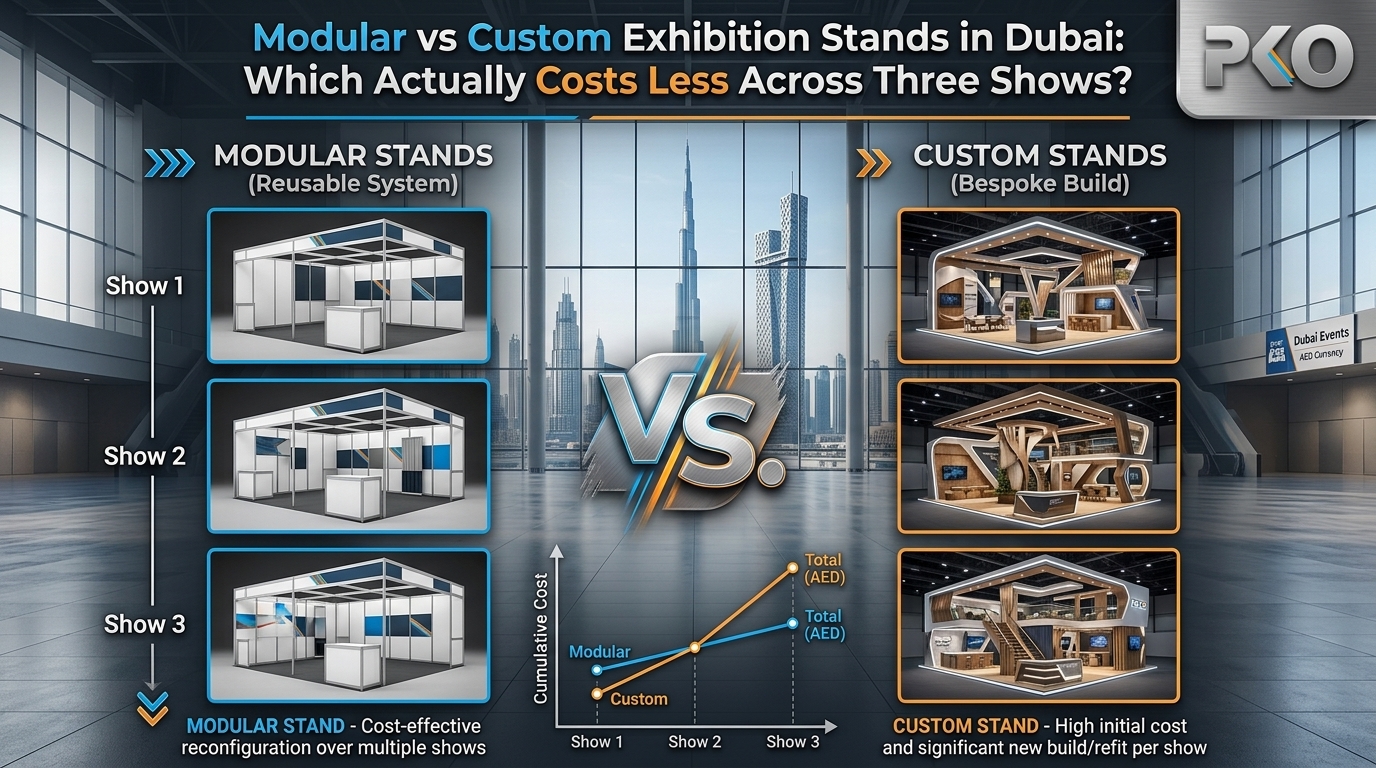
Modular vs Custom Exhibition Stands in Dubai: Which Actually Costs Less Across Three Shows?
Two quotations land on your desk for the same 6 by 3 metre space. One is a modular build, one is a custom build, and the modular option looks cheaper. Six months later you exhibit again, and the picture changes completely, because the second stand either goes back into a crate or gets built from scratch.
Single-show pricing hides most of what an exhibition programme actually costs. Storage, re-fabrication, freight volume, installation man-hours and graphic refreshes only show up from the second show onwards. Exhibitors who compare modular and custom stands across a full season of three exhibitions usually reach a different conclusion than those who compare only the first invoice.
This comparison looks at where the money goes at each of the three shows, which cost lines repeat, which disappear, and how to decide which format fits your exhibition plan in Dubai.
Modular vs Custom Exhibition Stands: What Is the Difference?
Modular exhibition stands
A modular exhibition booth is assembled from an engineered component system, typically aluminium extrusion profiles, beam-and-upright frames, hook-and-slot panels or tension fabric framing. The parts are standardised, bolted or clipped together, and designed to be taken apart and rebuilt in a different configuration. Graphics are usually fabric or printed panels that slot into the frame rather than being fixed to the structure.
The practical consequence: the structure is an asset you keep, and each subsequent show pays for assembly and new graphics rather than new construction.
Custom exhibition stands
A custom exhibition stand is built for one brief. Walls are usually joinery, MDF, plywood or aluminium framing with skinned finishes, sprayed paint, laminates, timber slats and bespoke shapes. Elements are cut to size for that specific layout, so reuse is partial at best. Some components, such as counters, display plinths, lockable stores and light boxes, can be recovered and refurbished for a later show; the wall carcass rarely can.
The middle ground
Many larger stands in Dubai end up hybrid: a modular skeleton carrying the wall lines and upper structure, with custom joinery for reception counters, product display and feature walls. That combination is often where the cost comparison actually lands, rather than at either extreme.
Companies moving up from a basic organiser package can compare that route first by reviewing what a shell scheme upgrade in Dubai typically involves, since it sits between doing nothing and commissioning a freestanding build.
What Goes Into the Cost of an Exhibition Stand in Dubai?
Stand construction is only one line item. The full cost of exhibiting includes:
- Design and visualisation: concept development, 3D renders, technical drawings and revisions.
- Structure and materials: frames, panels, flooring, ceiling or rigged elements, and the finish specification, which drives cost more than most exhibitors expect.
- Fabrication and labour: workshop time for carpentry, spraying, assembly and pre-build checks.
- Graphics and print: large-format panels, fabric prints, vinyl, light box faces and signage elements.
- Electrics, lighting and AV: power distribution, spotlights, screens and mounting.
- Venue and organiser requirements: stand plan submission and approval, height and rigging rules, fire-retardancy documentation for materials, contractor passes, build-up and breakdown time slots, and any deposits or bonds the organiser applies.
- Transport and logistics: workshop-to-venue delivery, crating, lifting equipment, and the volume and weight of what is being moved.
- Installation and dismantling: on-site man-hours during restricted build-up windows, plus removal and waste disposal.
- Storage between shows: warehousing, crates, condition checks and refurbishment of returned parts.
- Modifications: changes to size, layout, messaging or product display before the next exhibition.
Venue paperwork deserves attention early, because approval timelines affect labour planning rather than just compliance. Anyone exhibiting at Dubai World Trade Centre should factor in the documentation involved in getting a stand plan approved at DWTC, particularly for double-decker structures, rigging and complex custom builds.
Actual figures vary widely with size, storey count, finish level, graphic area, AV content and logistics, which is why a like-for-like comparison matters more than a headline rate. The way stand costs are structured through the design and build process is a more reliable guide than any published price per square metre.
Three-Show Cost Comparison: Modular vs Custom
The useful comparison is not price per show but how each cost line behaves when the same brand exhibits three times, for example a sector show in spring, a regional trade fair mid-year, and a larger international exhibition at the end of the year.
| Cost area | Modular across three shows | Custom across three shows |
|---|---|---|
| Design | Paid once, then adapted. Layout changes reuse the same component library. | Usually re-engineered whenever the space size or shape changes. |
| Structure | Bought once and carried forward. Additions are incremental. | Rebuilt for each new footprint unless the layout is repeated exactly. |
| Graphics | Replaced each show. Frames stay, prints change. | Replaced each show, and often bonded to panels, so the panel goes too. |
| Installation | Shorter, lighter crews once the system is familiar. | Longer build-up with more trades on site. |
| Transport | Lower volume and weight. Parts crate flat and dense. | Bulkier loads, more protection, more handling. |
| Storage | A real recurring cost, and the price of reusability. | Minimal if the stand is scrapped, higher if parts are kept. |
| Modifications | Reconfiguration using existing parts plus a few new pieces. | New fabrication for most changes. |
| Waste | Low. Very little is discarded. | High if the structure is not recovered after each show. |
Illustrative index only, not Dubai market rates. To show the pattern, set the first custom build at an index of 100 and track relative spend, assuming the same size at Show 2 and a larger, different layout at Show 3.
| Stage | Modular (index) | Custom (index) |
|---|---|---|
| Show 1 | 85 to 100 | 100 |
| Show 2, same size, new graphics | 30 to 45 | 70 to 90 |
| Show 3, larger and different layout | 35 to 55 | 80 to 100 |
| Three-show total | Roughly 150 to 200 | Roughly 250 to 290 |
The numbers above are a modelling device, not a quotation. What is consistent across real exhibition programmes is the shape of the curve: modular spending front-loads and then falls sharply, while custom spending repeats at close to full cost each time the stand is rebuilt. Storage fees, refurbishment and replacement parts flatten the modular saving but rarely reverse it over three shows.
One caveat changes the maths: if each of your three shows has a different stand size, a different orientation, or an open-on-four-sides island space instead of a corner, the modular system needs enough components to cover the largest configuration. Buying a kit sized only for the smallest show means topping it up twice.
Why Modular Stands Can Become More Cost-Effective Over Three Shows
- The structure is an asset, not a consumable. Shows two and three pay for assembly, graphics and logistics instead of fabrication.
- Reconfiguration replaces redesign. A 3 by 3 metre corner layout can be rebuilt as a 6 by 3 metre in-line or an open island using the same profiles, with new panels only where the footprint grows.
- Graphics carry the change of message. A refreshed campaign, a new product line or a different audience can be handled by reprinting panels and fabric rather than rebuilding walls.
- Freight volume drops. Extrusion and rolled fabric pack far more efficiently than finished joinery, which matters for both local delivery and any cross-border movement between GCC exhibitions.
- Installation is faster. Fewer man-hours inside a tight build-up window reduces labour cost and the risk of overtime charges when access is delayed.
- Damage is localised. A scratched panel or bent profile is a part replacement, not a rebuild.
- Less waste. Reduced disposal at breakdown, which also supports sustainability commitments that many organisers and corporate buyers now ask about.
Two supplier decisions determine whether those savings materialise. The first is print: reusable frames only pay off if the panel sizes are standardised so that replacement graphics and printed panels can be produced to the same dimensions for every show. The second is component quality, since a system that will be handled six times needs parts fabricated for repeated assembly rather than for one installation.
When a Custom Exhibition Stand Can Still Make More Financial Sense
A higher first-show cost can be the right commercial decision in several situations:
- Architectural impact is the objective. Curved forms, cantilevers, sculpted ceilings and double-decker structures are difficult to achieve convincingly within a standard component system.
- Large island spaces. Above roughly 100 square metres, visitor flow, sightlines and zoning usually need purpose-built geometry rather than repeated modular bays.
- Complex functional requirements. Enclosed meeting rooms, a working kitchen or bar, secure display cases, heavy machinery loads or storage that must be hidden from the aisle.
- Premium brand positioning. Sectors such as jewellery, automotive, luxury hospitality and high-end real estate are judged on finish quality, and visible system joints can undercut the message.
- Multiple activations in one space. Demonstration areas, product theatres, AV walls and hospitality zones integrated into the structure.
- One flagship show per year. If you exhibit once annually at a single major exhibition, there is no second or third show to amortise a modular investment against, and storage adds cost without return.
Where visitor journey and zoning are the real drivers, the decision belongs with the design team planning the layout and visitor experience before any format is fixed, because the same brief can often be met at two very different price points. Execution then depends on whether the booth construction and on-site build can deliver the specified finishes inside the venue’s build-up schedule.
Modular vs Custom: Three-Show Decision Checklist
Work through these before requesting quotations:
- Number of shows: three or more in 18 to 24 months favours modular. One flagship show favours custom.
- Booth size consistency: similar sizes across shows favour modular; wide variation needs a system specified for the largest space.
- Layout type: in-line and corner spaces suit modular. Four-sided island spaces often need custom geometry.
- Brand requirements: seamless premium finishes and unusual shapes push towards custom.
- Storage: do you have warehouse space, or will you pay for it? No storage plan removes most of the modular advantage.
- Transport: local Dubai shows only, or movement to Abu Dhabi, Riyadh or further? Repeat freight strengthens the modular case.
- Graphic change frequency: frequent message changes favour a frame-and-panel approach.
- Budget shape: can you fund a higher capital spend now for lower spend later, or does each show need its own contained budget?
- Ownership intent: do you want to own an asset, or keep stands off the balance sheet and rent per show?
If the budget answer is the constraint, it is worth reviewing cost-efficient stand design options available in Dubai before defaulting to the cheapest single-show quote, because a low first invoice often carries the highest three-show total.
Which Option Should You Consider for Three Shows in Dubai?
There is no universal winner. The answer follows your exhibition calendar, not the format itself.
Choose modular when
- You have three or more exhibitions confirmed or likely within two years.
- Stand sizes are similar, or the variation is predictable.
- Messaging changes more often than structure.
- Storage and handling are solved, either in-house or through your contractor.
- Speed of build-up and repeat freight efficiency matter to you.
Consider custom when
- One show carries most of your annual commercial weight.
- The space is large, open-sided, or needs a second storey.
- Finish quality and architectural distinctiveness are part of the brand promise.
- The stand must host meetings, demonstrations or hospitality as built-in functions.
Consider a hybrid when
- You want reuse of walls, structure and lighting, but bespoke reception, product display and feature elements.
- Your shows range from a small in-line space to a substantial island stand.
The short answer for most regular exhibitors: across three shows of broadly similar scale, a reusable exhibition display generally produces the lower total cost, provided the system is specified for the largest space from the outset and storage is accounted for honestly. Across three shows of very different sizes and formats, or where one show dominates, the custom route can be justified on impact rather than on cost per show. Judge both on total programme cost and on leads generated, not on the first quotation.
Planning a Reusable Exhibition Stand in Dubai?
PKO Exhibitions and Events works with exhibitors across Dubai and the wider UAE on both reusable modular systems and custom builds, covering design, fabrication, graphics, installation and dismantling. If you are weighing the two approaches for an upcoming season, the practical starting point is a full-service exhibition stand plan that maps your confirmed and likely shows before the format is chosen, so the structure is sized for the whole programme rather than the next event alone.
Share your show list, space sizes and layout types, and you can discuss your exhibition requirements and get a three-show cost view rather than a single-show price.
Frequently Asked Questions
Are modular exhibition stands cheaper than custom stands in Dubai?
Not necessarily at the first show, where the two can be close in price for the same size and specification. The difference appears from the second show onwards, because the modular structure is reused while a custom stand is often rebuilt. Over three exhibitions of similar scale, modular usually produces the lower total, once storage and refurbishment are included.
Can a modular exhibition stand be reused for multiple shows?
Yes, and that is the basis of its cost advantage. Component systems are designed for repeated assembly, with parts replaced individually when damaged. The limits are practical: the kit must contain enough components for your largest space, panels need consistent sizing, and parts need proper crating and condition checks between shows.
What affects exhibition stand cost in Dubai the most?
Size and storey count first, then finish specification and graphic area. Beyond construction, the significant variables are venue and organiser requirements, rigging, electrics and AV, freight volume, and the man-hours needed during a restricted build-up window. Two stands of identical square metres can differ substantially on finish and complexity alone.
Is a custom exhibition stand worth the higher investment?
It is when the stand has to do something a component system cannot: unusual architecture, a double-decker, a large open island space, enclosed meeting rooms, or a premium finish where visible joints would weaken the brand. It is harder to justify when you exhibit frequently in similar spaces and the structure is discarded each time.
Can modular stands be redesigned for different exhibitions?
They can be reconfigured rather than redesigned. The same profiles and panels can form different footprints, wall heights and entry points, with additional components added where the space is larger. Expect to budget for new graphics each show and some new parts whenever the configuration grows.
What additional costs should I plan for besides stand construction?
Graphics replacement, transport both ways, installation and dismantling labour, on-site power and lighting, storage between shows, refurbishment of returned components, venue submissions and contractor passes, and waste disposal at breakdown. These recurring items are where three-show comparisons are usually won or lost.
How do I compare exhibition stand costs across three shows properly?
Ask each supplier to quote the same three spaces, and to separate one-off costs from repeating ones. Then add your own storage, transport and graphics assumptions to both options and total the three shows. Comparing a single-show figure against a three-show figure is the most common error in stand budgeting.