
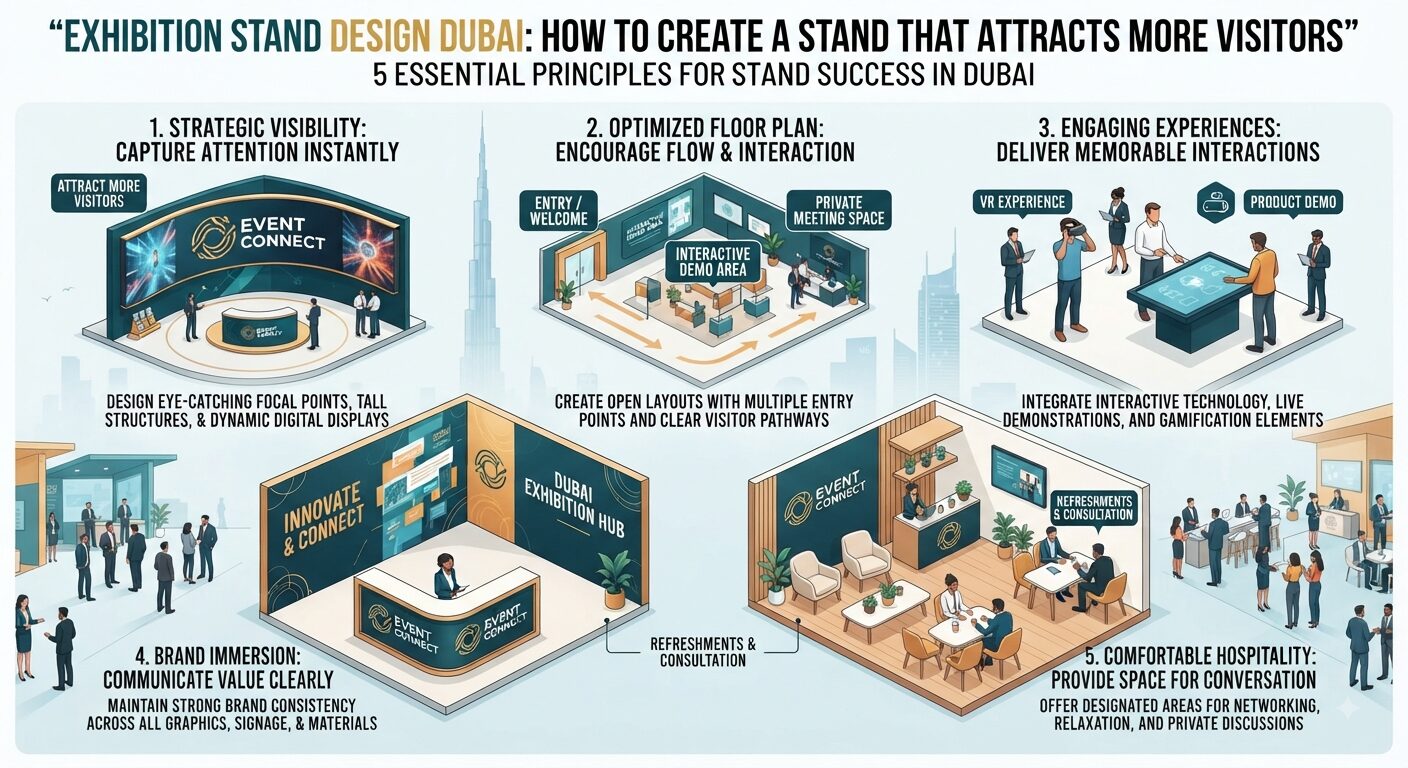
Exhibition Stand Design Dubai: How to Create a Stand That Attracts More Visitors
Dubai’s exhibition environment brings together brands, buyers, investors, and industry professionals from around the world, making it increasingly important for exhibitors to create a stand that captures attention within seconds. With thousands of exhibiting companies competing for visibility at major trade shows, simply displaying a logo and products is not enough to encourage visitors to stop. Effective Exhibition Stand Design Dubai combines visual impact, clear brand messaging, strategic space planning, lighting, graphics, product presentation, technology, and an inviting visitor flow to create a stand that people notice and want to explore. A well-designed exhibition booth should guide visitors naturally from their first glance to entry, interaction, conversation, and ultimately a meaningful business connection. For brands exhibiting in Dubai, the challenge is therefore not only to build an attractive structure but to create an experience that communicates value quickly while supporting practical business objectives. This is where experienced Exhibition Stand Designers in Dubai can help transform a brand concept into a purposeful exhibition environment, where every design element has a role in attracting visitors, communicating the brand, and encouraging engagement.
What Makes an Exhibition Stand Attract More Visitors?
An exhibition stand attracts visitors when its design makes the brand easy to notice, understand, and approach. In a busy trade show environment, visitors are constantly moving between different booths, so a successful stand needs to create a clear visual and physical invitation rather than relying on decoration alone. The strongest exhibition stands combine a distinctive appearance with practical visitor-focused planning, allowing people to recognise the brand from the aisle, understand what it offers, and see a clear reason to step inside.
Immediate Visual Recognition
The first impression begins before a visitor enters the booth. Strong branding, well-positioned logos, clear messaging, distinctive architectural elements, and high-quality exhibition graphics can help a stand remain visible within a crowded exhibition hall. The visual hierarchy should make the most important information noticeable first, followed by supporting product or service information. Instead of filling every surface with text and images, the design should communicate the brand identity and primary message quickly from different viewing angles.
A Clear Reason to Enter
Visibility alone does not guarantee footfall. Visitors need a reason to approach the exhibition booth, whether that is a product demonstration, an interactive display, a new-product presentation, a consultation opportunity, or an experience relevant to their needs. The design should make these engagement points visible from outside the stand so visitors can immediately understand what they can discover inside. A strategically positioned hero product, demonstration counter, digital display, or live presentation can create curiosity and encourage people to move closer.
An Open and Welcoming Layout
The physical arrangement of the stand also influences whether visitors feel comfortable entering. Excessive walls, crowded furniture, blocked entrances, and poorly positioned displays can make an exhibition stand feel difficult to approach. An open layout with clear sightlines and accessible entry points allows visitors to see what is happening inside before they commit to entering. Depending on the exhibition space and brand objectives, open or island-style configurations can provide visibility from several directions while supporting smoother visitor movement.
A Logical Visitor Journey
An effective Exhibition Stand Design Dubai should consider what happens after a visitor notices the stand. The experience can be planned as a simple sequence: attract attention → encourage entry → introduce the brand → engage the visitor → start a conversation → support the next business step. This visitor journey connects the stand’s architecture, graphics, product displays, technology, seating, and staff interaction into one cohesive experience. When each element supports the next stage, the stand becomes more than an attractive structure; it becomes a purposeful environment designed around visitor behaviour and business objectives.
The next step is to turn these principles into specific design decisions, beginning with the most important one: defining exactly what the exhibition stand needs to achieve.
Start With a Clear Exhibition Objective
Before selecting colours, materials, lighting, furniture, or architectural features, an exhibitor should establish what the stand needs to accomplish. A visually impressive booth can still underperform if its design does not support a clear business purpose. The objective determines how visitors should move through the space, what they should notice first, which areas require the most attention, and how the stand should encourage meaningful interactions.
An exhibition stand may be designed primarily for brand awareness, lead generation, product demonstrations, new-product launches, distributor meetings, sales conversations, or industry networking. Each objective requires a slightly different spatial strategy. A company focused on lead generation may need an easily accessible reception and interaction area, while a technology brand demonstrating a complex product may require dedicated demonstration stations and viewing space. A B2B company focused on high-value discussions may place greater emphasis on comfortable meeting areas without making the overall stand feel closed or uninviting.
The objective should also influence the visitor journey. A useful structure is attract → enter → explore → interact → discuss → convert. The external design captures attention, the entrance removes barriers to engagement, the display areas communicate the offer, interactive elements encourage deeper involvement, and dedicated discussion spaces provide an environment for qualified conversations. This approach helps ensure that every part of the stand contributes to the same purpose rather than competing for attention.
For Exhibition Stand Design Dubai, defining the objective is particularly important because the stand must work within a busy exhibition environment where visitors have limited time and many competing points of interest. A clear objective allows Exhibition Stand Designers in Dubai to develop a concept that balances visual impact with functionality, ensuring that the final exhibition booth is not simply attractive but also aligned with the exhibitor’s goals.
Once the objective is established, the next challenge is communicating that purpose quickly. Visitors should be able to recognise the brand and understand its main message from the aisle, which makes strategic brand visibility the next essential part of stand design.
Make the Brand Visible From the Aisle
A visitor’s decision to approach an exhibition stand often begins several metres away, which makes aisle-facing visibility an essential part of Exhibition Stand Design Dubai. The stand should communicate the brand clearly before a visitor reaches the entrance, using a combination of architectural structure, signage, graphics, lighting, and concise messaging. The objective is not to display as much information as possible but to establish a strong visual hierarchy that allows the most important message to be recognised quickly.
Prioritise Clear Brand Placement
The company logo and primary brand identity should be positioned where they can be seen from the main visitor approaches. Depending on the stand configuration, this may include elevated signage, branded architectural elements, illuminated logos, or graphics placed across prominent walls. The positioning should complement the overall structure rather than appear as an afterthought. Consistent colours, typography, imagery, and brand elements also help visitors associate the physical stand with the company before they begin a conversation.
Use a Short and Relevant Main Message
A strong exhibition display should tell visitors what the company does or what they can discover without requiring them to read a long paragraph. A concise headline, product benefit, service statement, or campaign message can provide immediate context. Supporting information can then be placed deeper inside the stand for visitors who want more detail. This layered approach helps prevent the exterior from becoming overloaded with text while still giving interested visitors access to useful information.
Create a Strong Visual Hierarchy
Every element on an exhibition booth competes for attention, so the design should establish an intentional order. The visitor might first notice the brand name or headline, then a hero product or large graphic, followed by supporting information and finally an interactive or consultation area. Large-format exhibition graphics, strategic lighting, product displays, and architectural features can be used to guide this sequence.
A useful hierarchy is:
Brand → Main message → Hero visual or product → Supporting information → Engagement point
This structure helps visitors understand the stand progressively instead of confronting them with multiple competing messages at once.
Avoid Visual Clutter
Adding more graphics does not necessarily make an exhibition stand more effective. Excessive text, multiple competing headlines, crowded product displays, low-quality images, or too many decorative elements can make the stand difficult to understand from the aisle. The design should give important elements enough space to remain noticeable and ensure that the brand message remains stronger than secondary information.
Design for Multiple Viewing Directions
Exhibition visitors rarely approach every booth from exactly the same angle. A stand may be seen while people are walking past, approaching from a neighbouring aisle, or moving toward an adjacent exhibit. Exhibition Stand Designers in Dubai should therefore consider how branding, graphics, signage, and key displays appear from different directions. This is particularly important for corner, peninsula, and island stands, where several sides may contribute to visitor attraction.
When brand visibility, messaging, graphics, and architecture work together, the stand can communicate its identity before a staff member even begins a conversation. Once visitors recognise the brand and understand what it offers, the next design priority is making the physical space feel open enough for them to approach and enter comfortably.
Design an Open Layout That Encourages Footfall
A stand may attract attention from a distance, but the design must also make visitors feel comfortable approaching and entering it. An open, accessible layout can reduce physical and visual barriers while allowing people walking through the exhibition hall to see what is happening inside. For Exhibition Stand Design Dubai, the objective is to create a space that feels inviting without sacrificing areas needed for product demonstrations, staff interaction, storage, or business meetings.
Keep Entry Points Easy to Identify
Visitors should not have to search for where they can enter the stand. Clearly defined openings, unobstructed pathways, and visible activity near the front can make the space feel more approachable. If furniture, counters, displays, or structural elements block the entrance, visitors may simply continue walking even if the overall stand looks impressive.
Use Sightlines to Create Curiosity
A visitor should be able to see something interesting from outside the stand. A product demonstration, hero display, digital screen, distinctive architectural feature, or branded experience positioned within the visitor’s sightline can encourage people to investigate further. This creates a natural relationship between visibility and curiosity, helping the stand turn passing attention into physical footfall.
Avoid Unnecessary Physical Barriers
Large solid walls and excessive enclosed areas can restrict visibility and make a stand appear less accessible. Instead, designers can use partial partitions, transparent materials, open shelving, architectural frames, or strategically positioned branding to create separation without completely closing the space. Enclosed areas may still be valuable for private meetings, storage, or technical functions, but they should be integrated without compromising the stand’s overall openness.
Plan the Visitor Flow Before Placing Furniture
Furniture should support movement rather than dictate it. Reception counters, chairs, tables, product displays, demonstration units, and digital screens should be positioned so visitors can move naturally between different areas without creating bottlenecks. The route from the entrance to the main display and then toward engagement or meeting areas should feel intuitive.
A simple visitor-flow structure can be:
Aisle → Entrance → Main Display → Engagement Area → Consultation or Meeting Zone
This approach helps the stand accommodate both quick visitors who want to browse and prospects who are interested in a longer conversation.
Consider the Stand Configuration
The available position within the exhibition hall influences how openness should be achieved. An inline stand may rely heavily on its front-facing design and strong back-wall branding, while a corner stand can use two open sides to improve visibility. Peninsula and island configurations provide additional opportunities to attract visitors from different directions. The design should therefore respond to the actual floor position rather than applying the same layout to every exhibition space.
Balance Openness With Functional Zones
An open stand does not mean every part of the space must remain completely exposed. A successful Exhibition Stand Design Dubai can combine open visitor areas with carefully positioned zones for product demonstrations, staff discussions, storage, refreshments, and private meetings. The key is to maintain clear sightlines and easy circulation while giving each function an appropriate place.
For brands working with Exhibition Stand Builders in UAE, this balance should be considered during the design stage rather than after fabrication begins. The approved concept needs to account for structural requirements, materials, lighting, graphics, furniture, technical installations, and practical visitor movement together.
An open layout creates the physical invitation, but visitors still need to understand what makes the stand worth entering. Once the structure encourages approachability, the next step is using exhibition graphics and concise messaging to give visitors a clear reason to stop and explore.
Use Exhibition Graphics to Communicate Quickly
Once a stand is visible and approachable, its graphics need to explain the brand and its offering without making visitors work to understand the message. In a busy exhibition hall, people may only glance at a booth while walking past, so Exhibition Display Design Dubai should use graphics as a communication tool rather than treating them as simple decoration. The right combination of imagery, headlines, branding, product visuals, and supporting information can help visitors understand what the company offers and decide whether it is relevant to them.
Create a Clear Visual Message
The primary graphic should communicate one central idea. This could be a product benefit, brand promise, new launch, service category, or campaign message. A short headline supported by a strong visual is generally easier to process from an aisle than a large block of written information. Secondary details can be positioned within the stand for visitors who choose to explore further.
A useful structure is:
Headline → Key benefit → Supporting visual → Further information
This creates a natural information hierarchy and prevents every message from competing for attention.
Use High-Quality Product and Brand Imagery
Images should support the story being told by the stand. Product photographs, lifestyle imagery, diagrams, illustrations, and branded visuals can help visitors understand an offering before speaking with a representative. For technical or complex products, graphics can also simplify information through diagrams, comparisons, process illustrations, or concise feature explanations.
The quality of the imagery matters as much as its placement. Blurry photographs, inconsistent image styles, stretched graphics, or poorly prepared files can weaken an otherwise professional exhibition booth.
Keep Text Short and Readable
Exhibition graphics are viewed differently from website content or brochures. Visitors are usually standing or walking several metres away, meaning small text and long paragraphs are unlikely to communicate effectively. Headlines should be concise, typography should remain legible at the intended viewing distance, and supporting copy should be limited to information that genuinely helps the visitor understand the product or service.
A visitor should not need to stop and read a complete paragraph simply to discover what the company does.
Use Graphics to Guide the Visitor Journey
Graphics can also help direct attention from one area of the stand to another. For example, a large brand message may attract initial attention, while a product graphic directs visitors toward a demonstration area. Additional information can then introduce technical details before the visitor reaches a consultation or meeting zone.
This creates a visual pathway:
Brand recognition → Product interest → Information → Interaction → Conversation
When graphics are coordinated with the physical layout, they become part of the overall visitor journey rather than separate decorative elements.
Avoid Information Overload
One of the most common exhibition stand design problems is trying to communicate everything at once. Listing every service, product, certification, feature, statistic, and company achievement across the stand can make the message difficult to understand. Instead, prioritise information according to the visitor’s likely needs.
For example, the exterior may focus on the brand and primary offering, while deeper sections of the stand can contain product specifications, case studies, technical information, or digital content for visitors who want greater detail.
Maintain Consistent Event Branding
Every visible element should feel connected to the same brand identity. Colours, fonts, photography, icons, signage, digital screens, printed materials, and staff-facing areas should follow a consistent visual language. This consistency strengthens recognition and prevents the stand from appearing like a collection of unrelated displays.
For Exhibition Stand Designers in Dubai, this means integrating exhibition graphics, architecture, signage, lighting, and display elements during the design process rather than adding graphics only after the structure has been developed.
Consider Visibility From Different Angles
Graphics should be positioned according to how visitors approach the stand. Large logos and primary messages may need to appear on elevated or prominent architectural elements, while detailed product information can be placed at eye level within specific display zones. Corner, peninsula, and island stands may require different graphic strategies because visitors can approach from multiple directions.
The objective is simple: the visitor should quickly recognise who the brand is, what it offers, and why it may be worth exploring.
Strong graphics establish the message, but visual communication becomes even more effective when lighting directs attention to the right elements. The next stage of Exhibition Stand Design Dubai is therefore to use lighting strategically to highlight products, branding, architectural features, and visitor engagement areas.
Use Lighting to Create Visual Focus
Lighting plays an important role in determining what visitors notice first when they look at an exhibition stand. It can highlight a product, strengthen brand visibility, create depth within the structure, and make key areas easier to identify. In Exhibition Stand Design Dubai, lighting should therefore be planned as part of the overall design rather than added simply as decoration after the stand has been built.
Highlight the Most Important Elements
Not every part of an exhibition booth needs the same level of illumination. Accent lighting can be directed toward a hero product, branded wall, reception counter, architectural feature, or demonstration area to establish a clear visual hierarchy. When lighting reinforces the design, visitors can naturally understand which elements deserve their attention first.
A simple visual sequence can be:
Brand signage → Hero product → Demonstration → Conversation area
This allows lighting to support the same visitor journey established through the stand’s layout and exhibition graphics.
Make Branding Visible From the Aisle
Illuminated logos, backlit graphics, LED features, and carefully positioned architectural lighting can help a stand remain visible within a crowded exhibition hall. This is particularly useful when neighbouring exhibitors have large structures, bright displays, or competing visual elements. However, the objective should be distinction rather than excessive brightness.
Strong event branding works best when the lighting complements the brand identity and makes the most important visual elements easy to recognise.
Use Product Lighting to Improve Displays
Products should be illuminated according to their size, finish, colour, and viewing distance. Focused lighting can draw attention to a particular product, while integrated lighting within shelving or display structures can create a cleaner and more organised presentation. For products that require demonstrations, lighting can also help visitors focus on the specific area where the demonstration is taking place.
This becomes especially useful when an exhibition stand includes several product categories. Instead of presenting everything with equal visual emphasis, lighting can establish a clear priority between the main product and supporting displays.
Create Different Lighting Zones
Different areas of the stand can require different lighting approaches. A product demonstration may need focused illumination, while a meeting area may benefit from a more comfortable and balanced atmosphere. Reception areas should remain clearly visible, and branded architectural elements can use feature lighting to strengthen the overall appearance.
A well-planned lighting strategy can therefore divide the stand into functional zones without requiring unnecessary physical barriers.
Avoid Excessive or Distracting Lighting
More lighting does not automatically create a better exhibition display. Extremely bright fixtures, excessive flashing effects, poorly positioned spotlights, glare on screens, or inconsistent colour temperatures can make the stand uncomfortable and reduce the quality of the visitor experience. Lighting should support the brand and content rather than compete with them.
The same principle applies to digital displays. If a video wall or interactive screen is part of the stand, surrounding lighting should be planned to maintain screen visibility and prevent reflections.
Coordinate Lighting With the Stand Structure
Lighting should be integrated during the design and fabrication stages so that fixtures, cables, power requirements, ceilings, walls, signage, graphics, and architectural elements work together. This helps avoid last-minute compromises that can affect both appearance and functionality.
For Exhibition Stand Builders in UAE, early lighting coordination also makes it easier to account for technical requirements, installation access, power distribution, and venue regulations before construction begins.
Lighting is most effective when it directs attention toward something meaningful. Once the stand has used architecture, graphics, and illumination to capture attention, the next opportunity is to give visitors a reason to stay longer through interactive experiences and purposeful technology.
Build Interactive Experiences Into the Stand
Attracting a visitor is only the first stage of a successful exhibition experience. Once someone approaches the stand, the design should give them a reason to stop, explore, and interact with the brand. Interactive elements can make an exhibition booth more engaging by allowing visitors to experience a product, discover information, or participate in a demonstration rather than simply looking at printed displays.
Use Technology With a Clear Purpose
Touchscreens, digital catalogues, interactive product configurators, LED displays, augmented or virtual experiences, and digital presentations can add value when they are connected to a specific visitor need. For example, a company with a large product range could use a touchscreen catalogue to help visitors find relevant products quickly, while a technical brand could use an interactive demonstration to explain how a complex solution works.
The important point is that technology should support the visitor journey rather than become the main attraction without a meaningful purpose.
A useful relationship is:
Technology → Interaction → Understanding → Conversation
When technology helps visitors understand a product or service more easily, it can naturally create opportunities for staff to begin relevant conversations.
Create Visible Demonstration Points
Live demonstrations can be particularly effective because they provide a visible reason for people passing the stand to stop. A demonstration counter, product-testing station, working model, or scheduled presentation can create activity that is noticeable from the aisle.
The demonstration area should be positioned carefully. If it is hidden behind walls or placed in an area that cannot be seen from outside the stand, it may lose much of its potential to attract new visitors.
Make Interactive Content Easy to Use
An interactive feature should not require complicated instructions. Visitors should be able to understand what it does and how to use it almost immediately. Simple interfaces, clear prompts, responsive screens, and short demonstrations can make the experience more accessible to people who may only have a few minutes available.
The same principle applies to QR codes. A QR code can be useful for accessing a catalogue, product information, registration form, appointment booking page, or other relevant resource, but it should have a clear purpose and be accompanied by a short explanation of what visitors will receive after scanning it.
Connect Digital and Physical Displays
Technology should complement the physical exhibition display rather than operate as an isolated feature. A screen could explain the product positioned beside it, a digital presentation could support a live demonstration, or an interactive catalogue could help visitors explore products that cannot physically fit within the stand.
This creates a connected experience where:
Physical display → Digital information → Product understanding → Staff discussion
Such integration can make the stand more useful without filling the space with unnecessary technology.
Give Visitors Different Ways to Engage
Not every visitor wants the same level of interaction. Some may prefer to browse independently, while others may want a demonstration or detailed discussion with a representative. A strong Exhibition Stand Design Dubai should therefore offer multiple engagement levels, such as:
- Quick visual browsing
- Product exploration
- Interactive demonstrations
- Digital information
- Short staff conversations
- Detailed consultations
This allows visitors to choose their own path without making the stand feel overly structured.
Design Technology Around the Exhibition Environment
Interactive displays also introduce practical requirements that need to be considered during the design and build process. Screens, lighting, AV equipment, internet connectivity, electrical connections, mounting structures, and cable management all need appropriate planning. Equipment should also be positioned so that it does not obstruct circulation or create unnecessary queues.
For Exhibition Stand Designers in Dubai, this means technology should be included in the concept and technical planning from the beginning rather than added after the physical structure has already been finalised.
Measure Interaction by Business Value
The objective is not simply to make visitors spend more time at the stand. The interaction should help the exhibitor achieve a meaningful outcome, such as explaining a product, identifying a prospect’s requirements, collecting relevant information, scheduling a meeting, or moving the visitor toward a sales conversation.
Interactive experiences are therefore most valuable when they connect attention with engagement and engagement with business purpose.
Once visitors have a reason to interact, the next challenge is giving them a comfortable environment in which to continue the conversation. This makes dedicated meeting and conversation zones an important part of an effective exhibition stand.
Create Comfortable Zones for Conversations and Meetings
An exhibition stand needs to accommodate more than visitors who are simply passing through. Some prospects may want to ask questions, discuss product requirements, compare solutions, or explore a potential partnership in greater detail. Creating dedicated conversation and meeting zones allows these interactions to happen without disrupting the movement of other visitors. In Exhibition Stand Design Dubai, the key is to balance comfortable business spaces with an open and welcoming overall environment.
Create a Clear Reception or Welcome Point
A reception area can provide visitors with an immediate point of contact when they enter the stand. It can be used to welcome guests, understand their interests, direct them toward the relevant product or service area, and coordinate meetings with sales representatives.
The reception counter should remain visible without becoming a physical barrier. Positioning it too far inside the stand or surrounding it with unnecessary furniture can make the entrance feel less accessible.
Provide Open Conversation Areas
Not every visitor requires a private meeting. An open seating area can support short discussions, product questions, introductions, and initial consultations. Comfortable chairs, small tables, and sufficient space between seating areas can allow staff to speak with visitors without blocking the main circulation path.
These areas are particularly useful for prospects who want more information but are not yet ready for a formal meeting.
Add Semi-Private Meeting Spaces When Required
Businesses involved in B2B sales, professional services, technology, finance, healthcare, or complex solutions may need more private areas for detailed discussions. Semi-private meeting spaces can provide a greater degree of confidentiality while still maintaining a connection with the rest of the exhibition booth.
Partitions, architectural screens, glass elements, acoustic considerations, or strategically positioned structures can create privacy without making the stand appear completely closed.
Separate Visitor Zones According to Interaction Level
A useful exhibition stand can be organised into different levels of engagement:
Public zone → Engagement zone → Consultation zone → Private meeting zone
The public zone captures attention and welcomes visitors. The engagement zone supports product demonstrations or interactive experiences. The consultation area allows more focused conversations, while the private meeting zone can accommodate longer discussions or sensitive business information.
This layered approach helps different types of visitors use the stand comfortably at the same time.
Position Meeting Areas Without Losing Openness
A common mistake is allowing meeting rooms or large furniture arrangements to dominate the stand. If too much of the floor area is dedicated to enclosed spaces, the booth may become visually closed from the aisle. Meeting areas should therefore be positioned strategically so that the main branding, product displays, and visitor engagement points remain visible.
For example, a meeting room can be placed toward the rear of the stand while the front remains open for visitor interaction. In larger stands, multiple meeting zones can be distributed around central product or experience areas.
Consider Comfort and Dwell Time
Visitors who remain at the stand for a longer discussion need an environment that supports concentration. Seating height, table dimensions, lighting, temperature considerations, noise levels, accessibility, and sufficient personal space all contribute to the experience.
Comfort should not be treated as a luxury feature. A visitor who feels comfortable is more likely to remain engaged in a detailed conversation rather than ending the interaction quickly because the space feels crowded or uncomfortable.
Integrate Storage Without Affecting Visitor Space
Storage is another practical consideration. Bags, brochures, samples, staff belongings, packaging, and operational equipment need to be kept out of the main visitor area. Hidden storage integrated into counters, walls, or back-of-house spaces can help maintain a clean appearance.
This is where design and fabrication need to work together. Exhibition Stand Fabricators in Dubai can translate storage requirements into practical built-in solutions while preserving the visual appearance and circulation of the stand.
Design the Stand for Both Short and Long Interactions
The best exhibition environments can support different visitor behaviours simultaneously. A person who only wants to scan a product display should be able to move through the stand quickly, while a qualified prospect should have the option to sit down and discuss their requirements in greater detail.
This creates a flexible visitor experience:
Notice → Explore → Ask → Discuss → Meet
Once conversation areas are planned, the next priority is ensuring that the products themselves are presented in a way that makes them easy to understand. Product displays should not simply occupy space; they should help visitors quickly recognise what is being offered and why it matters.
Make Product Displays Easy to Understand
A well-designed product display should do more than fill an exhibition stand with products. It should help visitors quickly understand what is being presented, why it matters, and what they should explore next. In Exhibition Stand Design Dubai, product presentation needs to work alongside the stand’s architecture, graphics, lighting, and visitor flow so that the product becomes a natural part of the overall experience.
Give the Hero Product a Clear Position
If the exhibitor has a flagship product, new launch, or high-priority service, it should receive an appropriate position within the exhibition display. A hero product can be placed where it is visible from the main aisle or positioned along the visitor’s natural route through the stand.
Its surroundings should remain relatively uncluttered so that supporting products and graphics do not compete for the same attention. Strategic lighting, elevated positioning, a dedicated display structure, or a concise benefit statement can further establish its importance.
Organise Products by Visitor Need
When several products or services are presented, grouping them logically makes the display easier to navigate. Products can be organised by category, application, industry, solution type, or customer need rather than simply placing everything together.
For example:
Product category → Key benefit → Demonstration → Supporting information
This structure helps visitors move from general awareness toward more detailed understanding.
Make Products Easy to See
The height, spacing, orientation, and positioning of each product can affect how easily visitors understand the display. Items should not be hidden behind furniture, blocked by signage, or placed so close together that individual products become difficult to distinguish.
For larger products, sufficient surrounding space may be needed for visitors to walk around them or view demonstrations. Smaller products may benefit from shelving, display counters, transparent cases, or illuminated presentation units.
Combine Physical and Digital Information
Some products can be understood simply by seeing them, while others require technical explanations. Digital screens, touch displays, diagrams, product videos, QR codes, and interactive catalogues can provide additional information without overcrowding the physical display.
The physical and digital elements should complement each other. A visitor might first see the product, then use an interactive screen to explore its features, and finally speak with a representative about suitability or pricing.
This creates a natural sequence:
See → Understand → Explore → Discuss
Use Graphics to Explain Complex Products
For technical solutions, machinery, software, industrial products, healthcare equipment, or other complex offerings, product displays may require additional visual explanation. Diagrams, application illustrations, process graphics, comparison charts, and concise benefit statements can make complicated information easier to understand.
However, these visuals should be designed for exhibition viewing rather than copied directly from brochures or technical documents. The information needs to remain concise and readable within the physical environment.
Keep Product Demonstrations Accessible
If a product requires a demonstration, the surrounding space should accommodate both the presenter and visitors. There should be enough room for people to gather without blocking the main circulation route.
A demonstration area that is visible from the aisle can also become an attraction point, particularly when the activity provides a clear reason for visitors to stop.
Connect Product Displays With the Brand Story
Every product should contribute to the larger message of the stand. Visitors should be able to understand how the displayed products relate to the company’s expertise, brand positioning, or overall solution.
This can be achieved through consistent graphics, product descriptions, architectural presentation, lighting, and carefully selected messaging. Rather than creating isolated product zones, the stand can tell a connected story:
Brand → Problem → Solution → Product → Benefit → Conversation
Avoid Overcrowding the Display
Trying to showcase every product can weaken the impact of the most important offerings. A crowded exhibition booth can make products difficult to see and reduce the amount of space available for visitor interaction.
Prioritisation is therefore essential. Select the products that are most relevant to the exhibition objective and use digital or printed resources to provide information about additional offerings.
For Exhibition Stand Designers in Dubai, product presentation should be considered during the early design stage so that display dimensions, lighting, graphics, electrical requirements, technology, storage, and visitor circulation can be incorporated into the stand rather than added later.
When products are clearly presented, visitors can understand the offering without unnecessary effort. The next design consideration is making sure they can move through the stand comfortably, which brings visitor flow and accessibility into focus.
Design for Visitor Movement and Accessibility
An exhibition stand should be visually attractive, but its success also depends on how easily people can move through and use the space. Visitors may enter from different directions, stop at product displays, join demonstrations, speak with staff, or move toward a meeting area. If these activities compete for the same limited space, the stand can quickly become congested. Effective Exhibition Stand Design Dubai therefore considers visitor movement and accessibility from the beginning rather than treating them as final-stage details.
Create Clear Circulation Paths
Visitors should be able to identify where they can enter, move, pause, and exit without having to navigate around unnecessary obstacles. Reception counters, furniture, product displays, screens, pillars, and other structural features should be positioned carefully to maintain comfortable circulation.
A simple route can guide visitors through:
Entrance → Brand Introduction → Product Display → Interaction → Consultation
This does not mean every visitor must follow the same route. Instead, the layout should provide enough flexibility for people to explore according to their interests.
Avoid Bottlenecks Around Popular Features
Interactive screens, product demonstrations, reception desks, and promotional displays can attract groups of people. If these features are positioned in narrow areas, they can create queues or block access to other parts of the stand.
Designers should consider how many people might gather around an engagement point at the same time. Demonstration areas may require additional standing room, while seating zones should have enough space for visitors and staff to move without disrupting neighbouring conversations.
Keep Important Areas Visible
Good circulation is connected to visibility. Visitors should be able to see important areas such as product displays, demonstration zones, reception points, and meeting spaces without having to walk through a confusing arrangement of partitions and furniture.
Clear sightlines can also help staff identify approaching visitors and respond naturally when someone appears interested in a product or service.
Consider Accessibility From the Start
Accessibility should be incorporated into the stand layout rather than added after the design is complete. Entry points, circulation routes, display heights, seating arrangements, and interaction areas should be planned so that visitors with different mobility and access needs can use the stand comfortably.
Accessible design can also benefit the wider visitor experience by creating clearer routes, reducing unnecessary obstacles, and making important information easier to reach.
Position Furniture Around Movement
Furniture should support the purpose of each zone without consuming more floor space than necessary. Oversized sofas, excessive chairs, large tables, or poorly positioned counters can reduce circulation and make an otherwise spacious stand feel crowded.
A better approach is to select furniture according to visitor behaviour. A short product conversation may require only a small seating arrangement, while a longer business meeting may require a dedicated table and chairs. The furniture should fit the function rather than dominate the exhibition space.
Plan for Staff Movement as Well as Visitors
Staff members need to move between reception, product displays, storage, demonstration points, and meeting areas throughout the event. Their movement should not interfere with visitors or create unnecessary crossing paths.
Hidden storage and back-of-house areas can help staff access materials without bringing operational activity into the main visitor zone. This keeps the exhibition booth organised while allowing the team to work efficiently throughout the event.
Make the Stand Comfortable During Busy Periods
A stand that works well when only a few people are present may become difficult to navigate during peak visitor periods. Design planning should therefore consider realistic crowd levels rather than relying solely on an empty-floor visualisation.
The stand should have enough flexibility for:
- Visitors browsing displays
- Groups watching demonstrations
- Staff speaking with prospects
- Visitors waiting for meetings
- People moving between different zones
This is particularly important for popular products, presentations, and high-traffic exhibition periods.
Connect Movement With the Overall Visitor Experience
Visitor flow should not be treated as a separate technical consideration. It connects directly with branding, product presentation, engagement, and lead generation. When visitors can move naturally from one area to another, each design element has a better opportunity to perform its intended role.
The complete experience can therefore follow:
Visibility → Approachability → Entry → Exploration → Interaction → Conversation
For Exhibition Stand Builders in UAE, this means the design needs to be translated accurately into fabrication and installation. Structural elements, displays, lighting, graphics, furniture, technology, and storage must all be positioned according to the approved visitor-flow plan.
Once movement and accessibility have been addressed, the stand has the foundations of a complete visitor experience. The next step is to understand how these individual elements work together through visitor psychology from the first glance at the aisle to the final business conversation.
How to Design an Exhibition Stand Around Visitor Psychology
A successful exhibition stand is designed for people, not just products. Every visitor makes a series of decisions within a few moments whether to notice the stand, whether to approach it, whether to enter, and whether to continue the conversation. Understanding this behaviour helps transform Exhibition Stand Design Dubai from a visually attractive structure into a purposeful environment that encourages meaningful engagement. By considering visitor psychology during the design process, exhibitors can create experiences that feel intuitive, welcoming, and relevant.
The First-Glance Stage
The first interaction happens before a visitor reaches the stand. From across the exhibition hall, people quickly assess whether a booth is relevant to their interests. Clear branding, distinctive architecture, strategic lighting, high-quality graphics, and a visible hero product all contribute to this first impression.
At this stage, visitors are asking simple questions:
- Who is this company?
- What do they offer?
- Is it relevant to me?
If the stand answers these questions quickly, visitors are far more likely to move closer.
The Approach Stage
Once the stand captures attention, the next objective is encouraging visitors to change direction and approach the booth. An open layout, visible demonstrations, interactive displays, and active staff engagement help reduce hesitation.
Visitors are naturally drawn toward activity they can understand. A live product demonstration, a large digital display, or people actively interacting with a product creates social proof that something valuable is happening within the stand.
This stage can be summarised as:
Attention → Curiosity → Approach
The Engagement Stage
After entering the stand, visitors need reasons to remain. Product displays, demonstrations, digital experiences, informative graphics, and knowledgeable staff all contribute to a positive experience.
The environment should make exploration easy rather than overwhelming. Visitors should feel comfortable asking questions, interacting with products, or discovering information at their own pace.
At this point, the exhibition stand shifts from attracting attention to building interest and trust.
The Conversation Stage
Not every visitor is ready for an immediate sales discussion. Some may want technical clarification, while others may simply be gathering information for future decisions. Comfortable seating areas, accessible staff, and clearly organised consultation spaces make these conversations feel natural.
Rather than pressuring visitors, the stand should encourage open dialogue that helps identify their requirements and introduces appropriate solutions.
The Conversion Stage
The final stage is where interest becomes a genuine business opportunity. This could involve arranging a product demonstration, collecting contact information, scheduling a meeting, requesting a quotation, or discussing future collaboration.
The design should support this transition by providing suitable meeting spaces, clear lead-capture processes, and an environment where conversations can continue without interruption.
A complete visitor journey follows this progression:
Attention → Interest → Entry → Engagement → Conversation → Lead
Every design decision from graphics and lighting to furniture placement and visitor flow should contribute to moving visitors naturally through these stages.
Design Around Human Behaviour, Not Just Appearance
Many exhibition stands focus heavily on aesthetics while overlooking how visitors actually behave. An impressive structure may attract attention initially, but if people cannot understand the message, locate products, navigate the space, or comfortably speak with staff, the opportunity may be lost.
For Exhibition Stand Designers in Dubai, understanding visitor psychology helps balance creativity with functionality. The most effective exhibition environments are those that not only look distinctive but also guide visitors naturally from curiosity to meaningful business interaction.
Once visitor behaviour is understood, the next design decision is selecting the stand layout that best supports those interactions. Different configurations offer different advantages depending on the exhibition space, visitor traffic, and business objectives.
Choose the Right Exhibition Stand Layout for Your Objective
The physical configuration of an exhibition stand influences how visitors see the brand, where they enter, how they move through the space, and how easily they can interact with products or staff. There is no single layout that works for every exhibitor. The right choice depends on the available floor position, stand size, visitor traffic, level of openness required, number of products, meeting requirements, and overall exhibition objective. A well-planned Exhibition Stand Design Dubai should therefore select the layout based on how the space needs to perform rather than choosing a configuration purely for appearance.
Open or Island Exhibition Stand
An island stand is accessible from multiple sides and can create strong visibility within a busy exhibition environment. Its open configuration allows visitors to approach from different directions and can support a more immersive brand experience.
This layout can be suitable for brands that want to:
- Maximise visibility from surrounding aisles
- Encourage multiple visitor entry points
- Create prominent architectural features
- Showcase products from different directions
- Include larger demonstration or engagement areas
Because an island stand has fewer natural boundaries, the internal arrangement becomes particularly important. Product displays, meeting zones, reception points, and technology need to be organised without blocking the openness that makes the configuration effective.
Peninsula Exhibition Stand
A peninsula stand typically has several open sides while remaining connected to a neighbouring wall or structure. It can provide strong visibility while offering additional opportunities to use a rear section for branding, storage, meeting rooms, or product displays.
This configuration can work well for exhibitors looking for a balance between openness and defined functional zones. The open sides can attract passing visitors, while the rear structure can provide a visual anchor for the stand.
Corner Exhibition Stand
A corner stand benefits from visibility along two adjoining aisles. This provides more than one visitor approach direction and can make the stand easier to notice than an enclosed layout with a single front-facing entrance.
The design should take advantage of both visible sides through:
- Corner branding
- Open entry points
- Dual-facing graphics
- Visible product displays
- Strategically positioned engagement areas
Care should be taken not to treat one side as the “back” of the stand if both aisles contribute significantly to visitor traffic.
Inline Exhibition Stand
An inline stand generally has a more limited frontage, making the front-facing design particularly important. Strong back-wall branding, clear messaging, effective product displays, and an uncluttered entrance can help maximise the available space.
An inline configuration can be practical for exhibitors working with a smaller footprint or a defined budget. The design should prioritise what visitors can see from the aisle while using the internal area efficiently for product interaction, storage, reception, and conversations.
Custom Exhibition Stand
A custom stand provides greater freedom to develop an environment around a specific brand identity, product range, visitor journey, or exhibition objective. The architecture, graphics, lighting, furniture, technology, displays, and meeting areas can be designed as one integrated experience.
Custom Exhibition Stand Design Dubai can be particularly valuable when a company wants to:
- Create a distinctive brand environment
- Highlight a new product
- Develop an immersive experience
- Demonstrate complex solutions
- Integrate specialised technology
- Create dedicated meeting areas
- Make better use of an unusual floor configuration
Custom design does not mean adding unnecessary complexity. Its value comes from creating a stand where the structure and visitor experience are specifically aligned with the exhibitor’s goals.
Modular Exhibition Stand
A modular exhibition stand uses adaptable components that can be configured for different exhibition spaces and requirements. This approach can provide flexibility for businesses that participate in multiple events and want a stand solution that can be reused or modified.
Modular systems may be suitable when an exhibitor prioritises:
- Reusability
- Adaptability
- Consistent branding
- Efficient installation
- Different stand footprints
- Practical long-term use
The design should still maintain a strong visual identity. A modular stand does not need to look generic when graphics, lighting, product displays, and branding are thoughtfully integrated.
Match the Layout With Visitor Behaviour
The stand configuration should ultimately support the way visitors are expected to interact with the brand. A high-footfall product launch may require maximum openness and several engagement points, while a B2B company focused on consultations may need more defined meeting zones.
The relationship can be viewed as:
Business objective → Visitor behaviour → Stand layout → Functional zones → Visitor experience
This prevents the configuration from being selected in isolation.
Consider the Exhibition Position Before Finalising the Design
The same stand design may perform differently depending on its location within the venue. Nearby entrances, major aisles, neighbouring exhibitors, columns, traffic patterns, and available sightlines can all influence visibility and movement.
For Exhibition Stand Designers in Dubai, understanding the allocated floor position before finalising the concept allows the design to respond to actual visitor movement rather than relying solely on a standard template.
Once the appropriate configuration has been selected, visual creativity must be balanced with practical execution. An exhibition stand must not only look distinctive in a 3D concept; it must also be structurally practical, buildable, safe, accessible, and compatible with the requirements of the exhibition venue. This makes the relationship between creative design and practical exhibition requirements the next important consideration.
How to Balance Creativity With Practical Exhibition Requirements
Creative design gives an exhibition stand its visual identity, but creativity needs to work within practical boundaries. A concept may look impressive in a 3D presentation yet become difficult to fabricate, install, operate, or navigate if technical requirements are considered too late. Effective Exhibition Stand Design Dubai therefore brings creative planning and practical execution together from the beginning.
Make the Concept Buildable
Every architectural feature, display structure, ceiling element, branded surface, and decorative detail needs to be translated into a practical construction method. Materials, dimensions, structural support, finishing, lighting, electrical systems, technology, and installation access should be considered during the design stage.
This is where design and fabrication become closely connected. A visually ambitious concept may need to be adjusted if a particular material, structural element, or installation method is unsuitable for the exhibition environment.
Consider the Available Floor Space
The stand design needs to work within the exact dimensions and boundaries allocated by the organiser. Designers should consider not only the overall footprint but also how much space will be required for:
- Visitor circulation
- Product displays
- Demonstrations
- Reception
- Seating
- Meeting rooms
- Storage
- AV equipment
- Staff movement
- Technical installations
Using every available square metre does not necessarily produce a better stand. Some open space is essential to make the booth feel accessible and prevent visitor movement from becoming congested.
Plan Safety and Accessibility Early
Structural stability, electrical installations, access routes, display positioning, and other safety considerations should be incorporated into the design rather than addressed at the final stage. Accessibility should also influence entrance points, pathways, display heights, seating arrangements, and visitor circulation.
A design that looks attractive but creates obstacles or uncomfortable movement can negatively affect the visitor experience and may create problems during venue review.
Coordinate Technical Requirements
Modern exhibition stands often depend on more than physical construction. LED walls, interactive screens, lighting systems, audio equipment, internet-connected displays, charging points, product demonstrations, and other technology may require dedicated electrical and technical planning.
Power requirements and utility locations should therefore be considered before the final layout is approved. For example, placing a large digital display in a location without appropriate technical access can create unnecessary installation complications.
Understand Venue and Organiser Requirements
Every exhibition venue and event organiser can have specific rules relating to stand construction, technical services, access, rigging, utilities, working hours, installation, safety, and dismantling. These requirements can influence the final design.
At Dubai World Trade Centre, for example, exhibitors and contractors have processes covering stand construction, utilities, rigging, electrical services, and related technical requirements. Dubai Exhibition Centre likewise provides organiser and exhibitor services that involve planning, technical coordination, and venue-specific operational requirements.
This makes early coordination important. A concept should be developed with the actual exhibition environment in mind rather than being designed first and checked against venue requirements at the end.
Coordinate Design With Fabrication
Once the concept has been approved, the design needs to move through a controlled production process. Technical drawings, material specifications, graphic dimensions, structural elements, lighting positions, furniture, technology, and storage should be coordinated before fabrication begins.
The practical sequence can be represented as:
Design concept → Technical planning → Material selection → Fabrication → Installation → Inspection → Handover
A strong relationship between Exhibition Stand Designers in Dubai and Exhibition Stand Fabricators in Dubai helps ensure that the final structure remains faithful to the approved concept while meeting practical requirements.
Plan Installation and Dismantling From the Beginning
The work does not end when the stand leaves the fabrication facility. It must be transported to the venue, assembled within the permitted schedule, fitted with graphics and technology, checked, and prepared before the exhibition opens. After the event, it must also be dismantled and removed according to venue procedures.
Considering installation and dismantling early can influence material choices, component sizes, assembly methods, storage requirements, and the overall project schedule.
Protect Creativity Without Compromising Function
The objective is not to remove creative features simply because practical considerations exist. Instead, designers should identify which creative elements contribute most to the visitor experience and make sure those elements can be delivered effectively.
The strongest stand concepts achieve a balance between:
Visual impact + Brand communication + Visitor experience + Functionality + Buildability
When these factors are considered together, the final exhibition booth can look distinctive while remaining practical for visitors, staff, fabricators, and venue teams.
Once the creative concept has been aligned with practical requirements, the next stage is understanding how the complete design moves from an idea into a physical exhibition environment through design, fabrication, construction, installation, and project management.
How Exhibition Stand Design, Fabrication and Installation Work Together
An exhibition stand does not move directly from a design concept to a finished booth. Several connected stages are required to turn an idea into a functional exhibition environment. The design must be translated into technical drawings, materials need to be selected, components have to be fabricated, and the completed structure must be installed and checked at the venue. Understanding this relationship helps exhibitors see why Exhibition Stand Design Dubai should be planned alongside fabrication and installation rather than treated as a separate creative exercise.
Exhibition Stand Design
The process begins with understanding the exhibitor’s objectives, target visitors, available floor area, brand identity, product requirements, and desired visitor journey. Designers then develop the spatial concept, architectural elements, graphics, lighting, displays, furniture, technology, and meeting areas around those requirements.
A 3D visualisation can help the exhibitor understand how the completed stand may look before fabrication begins. It also provides an opportunity to review the placement of branding, product displays, visitor pathways, screens, seating, and other key features.
The objective is to create a design that is both visually distinctive and practical to build.
Exhibition Stand Fabrication
Once the design has been approved and technically developed, the concept needs to be converted into physical components. Exhibition Stand Fabrication Dubai can involve a combination of structural materials, carpentry, metalwork, display systems, printed graphics, signage, furniture elements, lighting structures, and custom-built features.
Fabrication quality directly influences the final appearance of the stand. Finishes, joints, graphic alignment, material quality, structural details, and component dimensions all need to match the approved concept.
A strong design therefore needs to account for fabrication realities from the beginning. Materials should be selected not only for appearance but also for durability, handling, installation, and suitability for the exhibition environment.
Exhibition Booth Construction
Fabricated components then need to be assembled into the complete exhibition structure. This can include walls, platforms, counters, display units, meeting rooms, overhead elements, signage, product structures, and other architectural features.
Construction must follow the approved technical plans while leaving appropriate space for electrical systems, lighting, AV equipment, graphics, storage, and visitor circulation.
For complex exhibition environments, coordination between the Exhibition Booth Contractors Dubai, designers, fabricators, technical teams, and venue representatives becomes particularly important.
Booth Installation
Installation brings the complete concept together at the exhibition venue. Fabricated components are delivered, assembled, connected, finished, and prepared for the event.
The installation stage can involve:
- Structural assembly
- Graphic installation
- Lighting setup
- Furniture placement
- Product display installation
- LED and screen integration
- Electrical connections
- AV equipment
- Signage
- Final cleaning and finishing
- Pre-opening inspection
The stand should be checked from both the visitor’s and exhibitor’s perspective before the event opens. Branding should be visible, pathways should remain clear, displays should function correctly, and technology should be tested.
Exhibition Project Management
Project management connects all these stages. An exhibition stand can involve multiple parties, including the exhibitor, designer, fabricator, contractor, venue, AV supplier, furniture provider, and technical teams. Without proper coordination, delays or inconsistencies can appear between the design and the finished stand.
A structured process helps coordinate:
Brief → Concept → 3D Design → Approval → Technical Drawings → Fabrication → Delivery → Installation → Testing → Handover → Dismantling
This is particularly valuable when working within fixed exhibition schedules, where delays during one stage can affect every stage that follows.
Maintain Design Consistency From Concept to Completion
The finished stand should remain faithful to the approved design while responding to practical site conditions. Changes may sometimes be required because of venue restrictions, material availability, technical requirements, or installation conditions, but these should be managed carefully so that the core visitor experience is not compromised.
For Exhibition Stand Builders in UAE, maintaining consistency means paying attention to the details that visitors see directly: graphic positioning, lighting, product displays, finishes, signage, furniture, technology, and overall cleanliness.
Why Design-to-Build Coordination Matters
A visually impressive concept has little value if the finished stand does not deliver the same experience. Design, fabrication, construction, and installation should therefore be treated as interconnected stages rather than separate services.
The relationship can be summarised as:
Design creates the experience → Fabrication creates the components → Construction creates the structure → Installation creates the finished environment → Project management keeps everything aligned.
When these stages are coordinated effectively, an exhibitor has a stronger foundation for delivering the intended visitor experience. However, even a well-designed and well-built stand must operate within the specific rules and technical conditions of its exhibition venue, making venue requirements the next important consideration.
Consider Venue and Organiser Requirements Early
A creative exhibition stand needs to work within the practical rules of the venue and event organiser. Stand dimensions, construction methods, electrical systems, rigging, access, safety, utilities, installation schedules, and dismantling procedures can all influence the final design. Addressing these requirements early helps prevent design changes, technical complications, or installation delays later in the project.
Check Stand Approval Requirements
Before fabrication begins, the approved stand concept may need to be submitted according to the organiser’s or venue’s procedures. Technical drawings, floor plans, structural information, electrical details, and other documentation may be required depending on the stand and event.
This means the design process should account for approval requirements from the beginning. A concept that has not been checked against the relevant venue conditions can require significant changes after the design has already been developed.
Understand Space and Height Restrictions
The allocated floor area determines much more than the overall size of the booth. Designers also need to consider boundaries, neighbouring stands, aisle access, sightlines, structural elements, and any applicable height limitations.
The available space should be divided according to actual visitor and operational needs, including:
- Visitor circulation
- Product displays
- Demonstration areas
- Reception
- Meeting spaces
- Storage
- Staff movement
- AV and technology
- Utilities and electrical requirements
The objective is to maximise the usefulness of the space without making the stand feel overcrowded.
Plan Electrical and Utility Requirements
Modern exhibition booths can require significant technical infrastructure. Lighting, LED walls, digital screens, interactive displays, charging stations, product demonstrations, and other equipment may require carefully planned electrical connections.
Utility requirements should therefore be identified before the final layout is approved. Electrical points, cable routes, equipment locations, and access requirements can affect where walls, counters, displays, and technology are positioned.
For Exhibition Stand Designers in Dubai, early technical coordination can prevent situations where a visually important feature cannot be installed or powered as originally intended.
Consider Rigging and Overhead Features
Some exhibition concepts include suspended signage, lighting structures, banners, or other overhead elements. These features can increase visibility, but they may be subject to venue-specific approval, structural, access, and technical requirements.
If overhead branding is part of the concept, it should be considered during the early design and technical-planning stages rather than added after the main structure has been finalised.
Plan Build-Up and Installation Access
The stand needs to be assembled within the venue’s permitted build-up period. Delivery routes, loading access, assembly sequence, workforce requirements, equipment, and installation time can all affect how the stand should be constructed.
Large or complex structures may need to be divided into practical components that can be transported and assembled efficiently. This is one reason why fabrication and installation planning should remain closely connected to the original design.
Prepare for On-Site Technical Coordination
The final exhibition environment can involve several teams working simultaneously. Stand contractors may need to coordinate with venue representatives, electricians, AV technicians, internet providers, rigging teams, furniture suppliers, and the exhibitor’s own staff.
A clear project-management process helps determine who is responsible for each requirement and when each task needs to be completed.
Follow Safety and Accessibility Requirements
Safety should remain part of the design throughout the project. Structural stability, electrical installations, visitor pathways, display positioning, access points, and other elements need to be considered according to the applicable venue and event requirements.
Accessibility should also be incorporated into the visitor journey. Entry points, circulation routes, seating, display areas, and interaction points should be planned to provide a usable environment for a broad range of visitors.
Treat Venue Requirements as Part of the Design
Venue requirements should not be considered an obstacle that is checked only after the creative work is complete. They are part of the design context. Knowing the rules early allows Exhibition Stand Contractors Dubai and Exhibition Stand Fabricators in Dubai to develop a solution that is both visually effective and practical to deliver.
A reliable planning sequence is:
Venue requirements → Design concept → Technical planning → Approval → Fabrication → Installation → Final inspection
This approach reduces the risk of discovering major constraints after fabrication has already started.
Once venue requirements have been accounted for, the next challenge is delivering the physical stand efficiently. This makes the relationship between design, fabrication, construction, installation, and project management essential to achieving the intended result.
How to Use Technology Without Overloading the Stand
Technology can make an exhibition stand more interactive, informative, and memorable, but adding digital features simply to make a booth look modern can have the opposite effect. Large screens, LED walls, touchscreens, interactive displays, and AV equipment should have a clear purpose within the visitor journey. In Exhibition Stand Design Dubai, technology works best when it helps visitors understand a product, discover relevant information, interact with the brand, or move naturally toward a business conversation.
Use LED and Video Walls Strategically
Large-format LED or video displays can attract attention from the aisle and provide a powerful platform for brand storytelling, product launches, demonstrations, and visual campaigns. However, the content should remain relevant to the exhibition objective.
A screen showing a clear product demonstration or concise brand story can provide value, while a screen displaying unrelated animations may attract temporary attention without encouraging meaningful engagement.
The screen should support the wider design rather than becoming the entire design.
Use Touchscreens for Exploration
Touchscreens can be useful when visitors need to explore information that cannot be displayed physically within the available floor space. A company with multiple products, services, configurations, case studies, or technical specifications can use an interactive interface to help visitors find information according to their interests.
The experience should be simple:
Choose → Explore → Understand → Ask
If visitors need extensive instructions before they can use the interface, the technology may create friction rather than engagement.
Integrate Digital Product Demonstrations
Digital demonstrations can explain complex products or services without requiring every feature to be physically displayed. Animations, product simulations, process diagrams, interactive models, and short videos can help visitors understand how a solution works.
For technical industries, this can be particularly useful when a product is too large, too complex, or impractical to demonstrate fully within the exhibition space.
Use QR Codes With a Clear Purpose
QR codes can connect the physical stand with digital resources such as:
- Product catalogues
- Technical specifications
- Case studies
- Registration forms
- Appointment booking
- Product videos
- Contact information
However, the visitor should understand what will happen after scanning. A simple label such as “View Product Catalogue” or “Book a Product Consultation” gives the QR code a clear purpose.
Avoid Screen Overload
Multiple screens do not necessarily create a better exhibition experience. Too many moving images, competing videos, bright displays, and digital messages can make it difficult for visitors to identify the most important information.
A better approach is to establish a hierarchy between digital and physical elements. One display may attract attention, another may explain the product, while a physical demonstration or staff conversation provides the deeper engagement.
The visitor should never have to decide between several competing digital messages simply to understand the brand.
Coordinate Technology With Lighting and Graphics
Technology needs to work with the rest of the stand. Bright LED displays can affect surrounding lighting, while poorly positioned spotlights can create reflections on screens. Digital content should also follow the same brand identity as printed exhibition graphics, signage, and physical displays.
This creates a consistent visual experience:
Architecture + Graphics + Lighting + Technology + Product Display
Plan Technical Requirements Before Fabrication
Screens, LED walls, interactive equipment, speakers, lighting systems, power connections, network access, cable management, and mounting structures should be included in the technical planning stage.
Adding technology after fabrication has already started can create problems with structural support, electrical access, equipment positioning, and visitor circulation. For this reason, Exhibition Stand Builders in UAE should coordinate technology requirements with the design and fabrication teams before production begins.
Make Technology Accessible to Different Visitors
Technology should not become the only way to understand the product. Some visitors may prefer speaking with a representative, examining a physical product, or reading concise printed information. Providing different ways to engage makes the stand more inclusive and flexible.
A strong exhibition experience might therefore offer:
Visual message → Physical display → Digital exploration → Staff interaction → Business discussion
Connect Technology With Business Objectives
The best technology has a measurable purpose. A touchscreen can help identify visitor interests, an interactive demonstration can explain a complex solution, a digital form can support lead capture, and an appointment interface can help schedule a follow-up meeting.
The goal is not simply to increase screen time. It is to make the visitor journey more useful and meaningful.
When technology is integrated thoughtfully, it can strengthen the stand without overwhelming its physical environment. The next consideration is to identify the design mistakes that can undermine visitor attraction, even when the stand includes strong branding, graphics, lighting, and technology.
Common Exhibition Stand Design Mistakes That Reduce Visitor Attraction
A stand can have a large footprint, expensive materials, advanced technology, and impressive architecture yet still struggle to attract meaningful visitor engagement. The problem is often not the lack of features but the way those features are planned. Effective Exhibition Stand Design Dubai requires every visual and functional element to support a clear visitor experience. Avoiding common design mistakes can help exhibitors create a stand that is easier to notice, approach, understand, and use.
Too Much Information
Trying to display every product, service, feature, achievement, certification, and company message can make the stand difficult to understand. Visitors often have limited time to process information while moving through an exhibition hall.
Better approach: Prioritise one main message and a small number of supporting points. Place detailed information deeper inside the stand or provide it through digital resources and staff conversations.
Weak or Hidden Branding
An attractive structure has limited value if visitors cannot identify the company behind it. Small logos, poorly positioned signage, inconsistent branding, or graphics hidden behind furniture can reduce recognition.
Better approach: Place the brand name and primary identity where they can be seen from the main visitor approaches. Use architecture, lighting, signage, and graphics to reinforce visibility.
A Closed-Off Entrance
Large walls, enclosed reception areas, excessive partitions, or furniture positioned directly at the entrance can make a booth appear difficult to approach.
Better approach: Maintain clear entry points and sightlines so visitors can see what is happening inside before entering.
Poor Visitor Flow
A stand may look impressive in a 3D design but become difficult to navigate when visitors, staff, products, furniture, and technology occupy the same space.
Better approach: Plan circulation before placing furniture and displays. Identify where visitors will enter, browse, interact, stop, and leave, then ensure these movements do not create unnecessary bottlenecks.
Overuse of Technology
Large LED walls, multiple screens, interactive displays, and digital effects can attract attention, but excessive technology may distract visitors from the actual brand or product.
Better approach: Give every digital feature a clear role. Use technology to explain, demonstrate, inform, or facilitate interaction rather than adding it simply for visual impact.
No Clear Product Focus
Displaying too many products without prioritisation can make it difficult for visitors to understand what the company wants them to notice.
Better approach: Identify hero products, services, or solutions and give them clear visual priority through positioning, lighting, graphics, or dedicated display areas.
Insufficient Meeting Space
A stand focused entirely on visual attraction may fail when several interested prospects want to have longer conversations. Without suitable seating or consultation areas, valuable discussions may happen in crowded visitor pathways.
Better approach: Include a suitable combination of open conversation areas and private or semi-private meeting spaces based on the exhibitor’s objectives.
Poor Lighting Strategy
Lighting that is too weak can reduce visibility, while excessive brightness, glare, inconsistent colour temperatures, or poorly positioned spotlights can make the stand uncomfortable.
Better approach: Use lighting to highlight branding, products, displays, and key architectural features while maintaining a comfortable environment.
Cluttered Furniture Placement
Large furniture arrangements can consume valuable floor space and restrict visitor movement. Excessive seating may also make the stand appear closed from the aisle.
Better approach: Select furniture according to actual visitor and business requirements, leaving sufficient room for circulation and interaction.
Designing for Appearance Instead of Visitor Experience
One of the biggest mistakes is treating the exhibition stand as a structure that needs to look impressive rather than an environment that needs to work for visitors. A visually striking stand may still underperform if people cannot understand its message, access its products, interact comfortably, or find someone to speak with.
Better approach: Evaluate every design decision by asking:
What will the visitor see? → What will they understand? → What will they do next?
Ignoring Venue and Technical Requirements
Designing without considering venue restrictions, electrical requirements, access, rigging, safety, installation schedules, and technical services can lead to costly changes later.
Better approach: Integrate venue and technical requirements into the design process before fabrication begins. This allows Exhibition Stand Contractors Dubai and Exhibition Stand Fabricators in Dubai to develop a stand that is both visually effective and practical to deliver.
Failing to Connect Design With Business Goals
A stand may attract large crowds without generating useful conversations if the visitor experience does not support the exhibitor’s actual objective.
Better approach: Connect the design to measurable business outcomes such as product demonstrations, qualified conversations, appointment bookings, lead capture, or customer engagement.
The central principle is simple: more features do not automatically create a better exhibition stand. A successful design uses the right combination of branding, layout, graphics, lighting, technology, product presentation, and meeting areas to create a focused visitor experience.
Once these common problems have been addressed, the stand can move beyond simply attracting footfall and begin guiding visitors toward meaningful business interactions and qualified leads.
How to Create an Exhibition Stand Design That Converts Visitors Into Leads
Attracting visitors is an important first step, but footfall alone does not determine whether an exhibition stand has delivered value. The design should help move relevant visitors from initial awareness toward interaction, conversation, and a meaningful next step. A strategic Exhibition Stand Design Dubai therefore considers lead generation as part of the visitor journey rather than treating it as something that happens separately from the physical stand.
Give Visitors a Clear Reason to Stop
A visitor should immediately understand why the stand is worth exploring. This reason could be a new product, a live demonstration, a relevant solution, an interactive experience, a product launch, or an opportunity to speak with a specialist.
The attraction point should be visible from the aisle and connected directly to the exhibitor’s objective.
For example:
Visible product → Demonstration → Visitor question → Staff conversation
This creates a natural transition from attention to engagement.
Create a Strong First Interaction
The first interaction should help identify what the visitor is interested in rather than immediately overwhelming them with information. Reception staff can welcome visitors, while clearly positioned product displays and graphics allow people to explore independently.
An effective stand should support both types of visitors:
- Those who want a quick overview
- Those who want to explore products
- Those looking for technical information
- Those ready for a detailed discussion
- Those interested in future collaboration
This flexibility prevents the visitor experience from becoming too aggressive or too passive.
Provide Useful Product Information
Relevant information helps visitors determine whether a product or service is suitable for their needs. Clear exhibition graphics, product demonstrations, digital catalogues, diagrams, specifications, case studies, and knowledgeable staff can support this process.
The information should be structured progressively:
Basic message → Product understanding → Detailed information → Consultation
This allows visitors to decide how deeply they want to engage.
Make Business Conversations Easy
Once a visitor shows genuine interest, the stand should provide a comfortable place to continue the discussion. Open conversation areas can support quick consultations, while dedicated meeting spaces can accommodate longer B2B conversations.
The design should also make it easy for staff to move visitors from a demonstration or display area toward a suitable discussion zone without forcing them through crowded spaces.
Build a Dedicated Lead-Capture Point
Lead capture should be simple and relevant to the visitor interaction. Depending on the business, this could involve:
- Digital registration
- QR-based forms
- Appointment scheduling
- Product enquiry forms
- Contact details
- Demonstration requests
- Sales consultations
The process should not interrupt the visitor experience. A visitor who has just completed a useful product discussion should be able to provide relevant information quickly rather than completing a long and unnecessary form.
Match Lead Capture With Visitor Intent
Not every visitor should be treated as an immediate sales prospect. Some may be researching solutions, comparing suppliers, looking for technical information, or simply becoming familiar with the brand.
A more useful approach is to identify visitor intent during the interaction and record information that supports appropriate follow-up.
For example:
General interest → Information sharing
Product interest → Product follow-up
Purchase intent → Sales consultation
Partnership interest → Business meeting
This makes the exhibition lead process more meaningful than simply collecting the highest possible number of contacts.
Use the Stand to Support Follow-Up
The visitor journey should not end when someone leaves the booth. The information collected during the interaction can help the sales team understand what was discussed and determine the appropriate next action.
A successful exhibition experience can therefore follow:
Visibility → Footfall → Engagement → Qualified Conversation → Lead → Follow-Up
The stand design supports the first five stages by creating an environment where meaningful conversations can take place. The exhibitor’s sales and marketing process then continues the relationship after the event.
Measure More Than Visitor Numbers
High visitor traffic can be encouraging, but it does not necessarily indicate success. Exhibitors can consider additional indicators such as:
- Number of meaningful conversations
- Product demonstrations completed
- Qualified leads
- Meeting requests
- Appointment bookings
- Product enquiries
- Partnership discussions
- Follow-up opportunities
This helps determine whether the design attracted the right visitors, not simply more visitors.
Align Design With the Conversion Objective
The physical stand should reflect the intended business outcome. A company focused on product demonstrations may need highly visible demo zones, while a B2B organisation may require a stronger balance between open engagement and private meetings.
For Exhibition Stand Designers in Dubai, this means understanding the exhibitor’s conversion objective before developing the final layout. The design should make it easy for visitors to move from curiosity to interaction and from interaction to a meaningful business conversation.
The most effective exhibition environment is therefore not necessarily the one with the biggest structure or the most technology. It is the one where every design element contributes to a clear visitor journey and a relevant business objective.
Once the stand’s conversion strategy is established, the next step is choosing the right professional partner to bring that strategy to life. This makes evaluating Exhibition Stand Designers in Dubai an important part of the exhibition planning process.
How to Choose Exhibition Stand Designers in Dubai
Choosing the right Exhibition Stand Designers in Dubai can influence everything from the initial concept to the visitor experience and final on-site execution. A designer should understand more than visual presentation; they should be able to translate an exhibitor’s objectives, brand identity, products, available space, and visitor journey into a practical stand concept. The selection process should therefore focus on design capability, technical understanding, fabrication coordination, project management, and the ability to deliver within the requirements of the chosen exhibition venue.
Review Previous Exhibition Stand Projects
Start by reviewing examples of completed exhibition stands rather than relying only on concept visuals. Look at how the designer has handled different industries, stand sizes, layouts, branding requirements, product displays, meeting areas, and visitor experiences.
A useful portfolio should demonstrate:
- Variety in stand configurations
- Quality of architectural design
- Effective brand integration
- Practical product displays
- Appropriate use of lighting
- Well-planned visitor movement
- Integration of technology
- Consistent finishing and presentation
The goal is not simply to find the most elaborate project but to determine whether the designer can develop a solution that fits your specific exhibition objective.
Check Design-to-Build Capability
A strong concept needs to be practical to fabricate and install. Ask whether the company can coordinate the complete process from design through production and on-site execution.
The workflow may include:
Brief → Concept → 3D Design → Technical Drawings → Fabrication → Installation → Handover
When design and production are closely coordinated, potential construction issues can be identified earlier and the final stand is more likely to reflect the approved concept.
Assess Understanding of Dubai Exhibition Venues
Dubai has a wide range of exhibition environments, and each event may involve specific operational, technical, and scheduling requirements. A suitable stand-design partner should understand the importance of venue coordination, including matters such as:
- Stand approval
- Floor-space limitations
- Access requirements
- Electrical services
- Lighting
- AV requirements
- Rigging
- Installation schedules
- Safety considerations
- Dismantling
This knowledge helps ensure that the creative concept remains realistic within the actual exhibition environment.
Evaluate Their Understanding of Your Brand
A good designer should first understand the company before suggesting a visual concept. The briefing process should consider:
- Brand identity
- Target audience
- Main products or services
- Exhibition objective
- Visitor profile
- Desired visitor journey
- Required meeting areas
- Product demonstrations
- Technology requirements
- Budget considerations
This information gives the designer a foundation for developing a stand that communicates the brand rather than applying a generic exhibition template.
Look for Strong Visitor-Experience Planning
Ask how the designer intends to attract visitors from the aisle and what happens after they enter. A good design should have an identifiable journey from visibility to engagement.
The designer should be able to explain:
How will visitors notice the stand?
Where will they enter?
What will they see first?
How will products be presented?
Where will conversations happen?
How will interested visitors move toward a business discussion?
These questions reveal whether the design is based on visitor behaviour rather than appearance alone.
Assess Communication and Project Management
Exhibition projects often involve strict deadlines, multiple suppliers, venue requirements, and several stages of production. Clear communication is therefore essential.
Ask who will be responsible for managing the project and how information will be communicated during:
- Design development
- Approvals
- Technical planning
- Fabrication
- Delivery
- Installation
- Event opening
- Dismantling
A defined point of contact can help reduce confusion when changes or technical issues arise.
Compare the Scope, Not Just the Price
When comparing Exhibition Stand Companies in Dubai, the lowest quotation may not represent the best overall value. Two quotations can have significantly different scopes even when they appear to offer similar stand sizes.
Review whether the proposal includes:
- Design and 3D visualisation
- Technical drawings
- Fabrication
- Exhibition graphics
- Lighting
- Furniture
- AV or digital displays
- Product displays
- Storage
- Installation
- Dismantling
- Project management
- Venue coordination
Comparing the complete scope provides a more realistic basis for evaluating cost and value.
Ask About Customisation and Flexibility
Some exhibitors need a completely bespoke environment, while others may benefit from modular solutions that can be adapted for multiple events. The right designer should be able to explain which approach fits the exhibitor’s objectives and why.
Custom Exhibition Stand Designers in Dubai can develop highly specific structures around a brand, product, or visitor experience, while modular approaches may be useful when adaptability and repeated use are priorities.
Consider Post-Design Execution
The relationship should not end when the 3D concept is approved. Ask how the company handles fabrication, installation, on-site adjustments, testing, handover, and dismantling.
This is especially important for complex projects involving custom structures, integrated technology, large graphics, product demonstrations, or multiple meeting areas.
For brands evaluating Exhibition Stand Designers in Dubai, the strongest choice is generally the partner that can demonstrate a clear understanding of the complete journey from business objective and visitor experience to design, fabrication, installation, and final delivery.
Once potential designers have been shortlisted, a practical set of questions can help an exhibitor compare their capabilities and understand exactly what will be included in the project.
Questions to Ask Before Hiring an Exhibition Stand Design Company
Choosing an exhibition stand partner is an important project decision because the designer may influence the concept, budget, fabrication, technical planning, installation, and overall visitor experience. Before appointing an Exhibition Stand Design Company Dubai, exhibitors should ask specific questions that reveal how the company approaches design, execution, communication, and venue requirements.
1. Can You Show Relevant Completed Projects?
Ask for examples of completed exhibition stands that are similar in size, industry, complexity, or objective to your planned project. This gives you a better understanding of the company’s practical capabilities than concept images alone.
2. What Is Included in Your Design Service?
Clarify whether the scope includes:
- Initial concept development
- 3D exhibition stand design
- Technical drawings
- Exhibition graphics
- Lighting planning
- Furniture selection
- Product display planning
- Digital integration
- Meeting areas
- Storage planning
A clear scope reduces the possibility of unexpected additions later.
3. Do You Handle Fabrication and Installation?
Find out whether the company manages the physical production and installation or coordinates with separate suppliers. If several parties are involved, understand who is responsible for communication and quality control at each stage.
A connected design-to-build process can simplify coordination between Exhibition Stand Designers in Dubai, fabricators, contractors, and venue teams.
4. How Do You Plan the Visitor Journey?
Ask how the proposed stand will attract people from the aisle and guide them through the space. A strong partner should be able to explain the relationship between entrance points, branding, product displays, demonstrations, meeting areas, and visitor circulation.
The design should answer:
How will visitors notice us?
Why will they approach?
What will they see first?
Where will they engage?
Where will the conversation continue?
5. How Do You Handle Venue Requirements?
Ask how the company manages venue and organiser requirements relating to technical approvals, stand dimensions, electrical services, access, rigging, safety, installation schedules, and dismantling.
This is particularly important for projects taking place in busy Dubai exhibition venues where multiple contractors and suppliers may be working within strict event schedules.
6. What Materials and Construction Methods Do You Recommend?
The company should be able to explain why particular materials or construction methods are suitable for the proposed design. Material decisions can influence appearance, durability, installation time, transportation, reuse, and overall project cost.
The objective should be to select materials according to the project’s requirements rather than simply choosing the most expensive or visually elaborate option.
7. How Do You Manage Changes During the Project?
Exhibition projects can evolve after the initial concept. Ask how design revisions, material changes, additional requirements, and technical adjustments are handled.
It is useful to understand:
- How revisions are communicated
- When design changes become chargeable
- How approvals are documented
- How changes affect production schedules
- Who gives final approval before fabrication
Clear change management can help prevent misunderstandings later.
8. Who Manages the Project on Site?
Ask whether a dedicated project manager or site representative will be available during installation. This person can coordinate the fabrication team, venue representatives, technical suppliers, and exhibitor requirements.
On-site responsibility becomes particularly important when the stand includes complex lighting, AV, digital displays, custom structures, or multiple functional areas.
9. What Happens During Final Handover?
Clarify how the completed stand will be checked before the exhibition opens. A final inspection should consider structural finishing, graphics, lighting, furniture, technology, product displays, cleanliness, storage, and visitor circulation.
The objective is to identify and correct issues before visitors arrive.
10. What Is Included in the Final Quotation?
Request a detailed quotation rather than evaluating a single total figure. The proposal should make clear what is included in the project and which items may carry additional charges.
Compare the scope of different Exhibition Stand Companies in Dubai across the same categories so that the decision is based on comparable information.
11. Can the Stand Be Reused or Adapted?
If the company plans to participate in multiple exhibitions, ask whether elements of the stand can be reused or redesigned for different floor sizes and event requirements.
A modular or adaptable approach may help maintain consistent branding while changing the layout for future exhibitions.
12. How Do You Measure Whether the Design Is Successful?
The company should be interested in more than whether the completed stand looks impressive. Ask how the design supports the exhibitor’s actual goals, such as product demonstrations, visitor engagement, qualified conversations, meetings, or lead generation.
This question helps distinguish a purely visual approach from one that considers the stand as part of a wider exhibition marketing strategy.
A Practical Evaluation Framework
After speaking with potential suppliers, compare them across five core areas:
Design quality → Technical capability → Fabrication and installation → Project management → Value and scope
A strong partner should be able to demonstrate capability across the complete process rather than only presenting attractive concept visuals.
For businesses searching for the Best Exhibition Stand Builder in Dubai, the right choice should ultimately be based on how well the company can turn the exhibitor’s objectives into a practical, engaging, and well-executed exhibition environment.
What Influences Exhibition Stand Design Cost in Dubai?
The cost of an exhibition stand in Dubai depends on much more than its floor size. Design complexity, materials, fabrication methods, technology, graphics, furniture, lighting, installation requirements, venue services, and the level of customisation can all influence the final budget. Understanding these factors helps exhibitors plan realistically and compare proposals from Exhibition Stand Companies in Dubai more accurately.
Stand Size and Floor Area
The available floor area is one of the first factors affecting the overall project scope. A larger stand generally requires more structural materials, flooring, graphics, lighting, furniture, electrical infrastructure, and installation work.
However, size alone does not determine cost. A smaller stand with complex custom architecture and advanced technology can require more production work than a larger but simpler modular layout.
Custom or Modular Construction
A modular stand may use adaptable components that can be reused or configured for different exhibition spaces. Custom-built stands are developed more specifically around the exhibitor’s brand, products, visitor journey, and available floor plan.
Custom Exhibition Stand Design Dubai may involve bespoke structures, specialised finishes, custom display units, integrated lighting, meeting rooms, or unique architectural elements, which can increase production requirements.
The appropriate option depends on the exhibitor’s objectives and whether the stand is intended for one event or multiple exhibitions.
Design Complexity
The complexity of the concept can affect both design and production time. Features such as curved structures, suspended elements, custom ceilings, unusual architectural forms, integrated product displays, private meeting rooms, and complex branded installations may require additional technical planning and fabrication.
Creative complexity should therefore have a purpose. Adding architectural features simply to increase visual impact may raise the cost without improving the visitor experience.
Materials and Finishes
Material selection affects appearance, durability, construction, transportation, installation, and budget. Different flooring systems, wall finishes, woodwork, metal structures, glass, acrylic, fabric graphics, lighting systems, and decorative materials can carry different production requirements.
A professional Exhibition Stand Fabricator in Dubai should be able to recommend materials according to the desired appearance, functional requirements, exhibition duration, and intended reuse.
Graphics and Branding
Exhibition graphics are essential for communicating the brand, but their cost can vary according to quantity, dimensions, materials, finishing, installation requirements, and complexity.
Large-format wall graphics, illuminated signage, 3D lettering, backlit fabric systems, digital displays, and custom branding structures can all affect the overall project scope.
Lighting
Lighting can range from basic functional illumination to a more developed system incorporating accent lighting, backlit branding, architectural lighting, product lighting, and integrated LED features.
A lighting plan should be developed around the stand’s visual hierarchy rather than adding fixtures without a clear purpose.
Technology and AV Equipment
Digital features can significantly influence the project budget. LED walls, touchscreens, interactive displays, computers, sound systems, video equipment, product demonstrations, and other AV requirements may involve both equipment costs and technical installation.
Technology should therefore be included in the initial brief so that structural and electrical requirements can be incorporated into the design.
Furniture and Meeting Areas
Reception counters, chairs, tables, sofas, stools, storage units, display counters, and meeting-room furniture all contribute to the project scope. A stand with several private meeting rooms may require substantially more furniture and internal construction than an open product-focused layout.
Furniture should be selected according to how visitors are expected to use the space.
Installation and Dismantling
The finished stand must be transported to the venue, assembled, fitted with graphics and equipment, inspected, and prepared before the exhibition begins. Afterward, it needs to be dismantled and removed according to the event schedule.
Installation complexity, stand size, working hours, access requirements, and the number of components can influence these costs.
Venue Services and Technical Requirements
Certain exhibition services may be handled through the venue or organiser and can form part of the overall exhibition budget. Depending on the event, exhibitors may need to account for services such as electrical connections, internet, rigging, cleaning, waste handling, technical support, or other venue-related requirements.
These costs should be identified separately when preparing the project budget.
Project Management
A complete exhibition project may involve designers, fabricators, electricians, AV teams, furniture suppliers, venue representatives, installers, and the exhibitor’s own staff. Coordinating these elements requires project management.
A quotation should make clear whether project management, venue coordination, technical submissions, installation supervision, and on-site support are included.
Reuse and Long-Term Value
A stand designed for repeated use may require a different investment strategy from a single-event booth. Modular components, adaptable graphics, reusable display structures, and flexible furniture can potentially be incorporated into future exhibition configurations.
The important question is not simply:
“What is the cheapest exhibition stand design price?”
A better question is:
“Which design approach delivers the required visitor experience and business value within the available budget?”
Compare Complete Scope Rather Than Headline Price
When comparing an Exhibition Stand Builder in Dubai, exhibitors should evaluate the complete scope of work. A lower initial quotation may exclude important services that appear later as additional costs.
Compare proposals based on:
Design + Materials + Fabrication + Graphics + Lighting + Technology + Furniture + Installation + Dismantling + Project Management
This gives a more realistic picture of the total project investment.
A clear budget helps determine which design features should receive the greatest priority. Once the cost structure is understood, the final stage is ensuring that the completed stand is reviewed against its original objectives and that its performance can be evaluated after the exhibition.
Measure Exhibition Stand Performance After the Event
A successful exhibition stand should be evaluated on more than appearance. A visually impressive booth can attract attention, but exhibitors ultimately need to understand whether the stand helped generate meaningful interactions and support business objectives. Measuring performance after the event allows companies to identify what worked, what needs improvement, and how future Exhibition Stand Design Dubai projects can be made more effective.
Start With the Original Exhibition Objective
Performance should be measured against the reason the company participated in the exhibition. The objective might have been to launch a product, generate qualified leads, meet existing customers, demonstrate a solution, build brand awareness, or develop business partnerships.
The design should be assessed against that original objective rather than using a generic definition of success.
Measure Visitor Engagement
Visitor numbers can provide an initial indication of how effectively the stand attracted attention, but engagement provides more useful insight.
Depending on the event, exhibitors can track:
- Number of meaningful conversations
- Product demonstrations
- Interactive experiences
- Enquiries
- Meeting requests
- Appointment bookings
- QR code scans
- Catalogue requests
- Product information requests
These indicators help show whether visitors were simply passing by or actively engaging with the brand.
Evaluate Lead Quality
The number of leads collected does not necessarily indicate the quality of the exhibition result. A large list of contacts with little relevance may be less valuable than a smaller number of qualified prospects.
Leads can be assessed according to factors such as:
- Relevance to the company’s offering
- Level of purchase interest
- Specific product requirements
- Decision-making role
- Expected purchasing timeline
- Potential business value
- Follow-up requirements
This helps connect exhibition activity with actual commercial opportunities.
Track Meetings and Follow-Up
Meeting requests and scheduled appointments can be useful indicators for B2B exhibitors. The sales team can track how many exhibition conversations progressed into follow-up calls, product demonstrations, quotations, meetings, or further negotiations.
A useful progression is:
Visitor → Conversation → Qualified Lead → Follow-Up → Sales Opportunity
This shows whether the stand successfully supported the transition from physical exhibition interaction to post-event business activity.
Gather Feedback From Visitors and Staff
Visitors can provide valuable insight into the clarity and usability of the stand. Simple feedback can reveal whether the messaging was easy to understand, whether products were displayed effectively, and whether the environment was comfortable.
Staff feedback is equally important. The people working inside the stand can identify practical issues that may not be visible in photographs or design reviews.
Ask staff:
- Was visitor movement easy?
- Were meeting areas sufficient?
- Could products be demonstrated comfortably?
- Was storage adequate?
- Were screens and technology reliable?
- Could staff easily identify approaching visitors?
- Did any area become overcrowded?
- Which features generated the most questions?
These observations can improve the next exhibition design.
Review the Stand Against Its Original Design
After the event, review whether the completed stand actually delivered the intended concept. Consider:
Brand visibility → Visitor flow → Product presentation → Lighting → Technology → Meeting areas → Staff usability
A strong post-event review can identify differences between what was planned and what visitors actually experienced.
Evaluate Cost Against Outcomes
Exhibition performance should also be considered alongside the overall project investment. Instead of looking only at the initial exhibition stand price, exhibitors can consider the relationship between project cost and meaningful outcomes such as qualified leads, meetings, product demonstrations, and business opportunities.
This creates a more useful evaluation of value than comparing stand prices alone.
Identify What Should Be Reused
If the company participates in several exhibitions, the post-event review can determine which elements should be retained, adapted, or redesigned.
For example, a business may decide to reuse:
- Modular structural components
- Product display units
- Furniture
- Lighting systems
- Storage solutions
- Digital equipment
At the same time, graphics, messaging, layout, or interactive elements may be adjusted according to the next event’s audience and floor plan.
Turn Results Into the Next Design Brief
The most useful outcome of post-event measurement is actionable information for the next exhibition. If visitors struggled to understand the main message, the graphics may need to be simplified. If meetings were consistently full, additional consultation space may be required. If a particular product demonstration attracted strong engagement, it may deserve greater prominence in the next stand.
This creates a continuous improvement cycle:
Plan → Design → Build → Exhibit → Measure → Learn → Improve
For businesses working with Exhibition Stand Builders in UAE, this approach turns each exhibition into an opportunity to refine the next visitor experience.
Ultimately, the best exhibition stand is not simply the one that looks impressive when the doors open. It is the one that attracts the right audience, communicates the brand clearly, supports meaningful interactions, and contributes to the exhibitor’s wider business objectives.
For a tailored exhibition environment that combines creative design, practical execution, and visitor-focused planning, PKO Exhibitions can help develop an exhibition stand aligned with your brand, space, and event goals. Contact PKO Exhibitions today to discuss your next exhibition stand design requirement in Dubai.
Conclusion: Design Your Stand Around the Visitor
Creating an exhibition stand that attracts more visitors requires more than an impressive structure. The strongest Exhibition Stand Design Dubai combines strategic branding, clear messaging, purposeful lighting, engaging product displays, interactive experiences, comfortable meeting areas, smooth visitor movement, and practical technology. Every element should have a defined role in taking visitors from first impression to exploration, interaction, conversation, and potential business opportunity. Choosing the right Exhibition Stand Designers in Dubai also matters because creative ideas need to be supported by technical planning, fabrication, installation, venue coordination, and project management. Whether the requirement is a custom exhibition booth, modular display, trade show stand, or bespoke branded environment, the focus should remain on creating a space that is visually distinctive, easy to navigate, relevant to the target audience, and aligned with the exhibitor’s objectives. PKO Exhibitions brings these considerations together to help businesses develop exhibition stands that combine creative design with practical execution. Contact PKO Exhibitions today to discuss your next exhibition stand design requirement in Dubai.
Frequently Asked Questions About Exhibition Stand Design Dubai
What makes a good Exhibition Stand Design Dubai?
A good Exhibition Stand Design Dubai combines strong brand visibility, clear messaging, practical visitor flow, attractive product displays, suitable lighting, purposeful technology, comfortable conversation areas, and a layout that supports the exhibitor’s business objectives. The design should attract attention from the aisle and then guide visitors naturally toward exploration, interaction, and conversation.
How do Exhibition Stand Designers in Dubai attract more visitors?
Exhibition Stand Designers in Dubai can attract visitors through a combination of distinctive architecture, visible branding, strategic lighting, strong exhibition graphics, open access points, product demonstrations, interactive displays, and clear messaging. The most effective approach is to create a reason for relevant visitors to stop rather than relying only on a visually complex structure.
What is the difference between exhibition stand design and fabrication?
Exhibition stand design is the planning stage in which the layout, architecture, graphics, lighting, visitor flow, displays, furniture, and technology are developed. Fabrication is the process of producing the physical components required to build that design. Installation then brings those components together at the exhibition venue.
Should I choose a custom or modular exhibition stand?
The right choice depends on the exhibitor’s objectives, event schedule, available space, budget, and reuse requirements. A custom exhibition stand can provide greater freedom for brand-specific architecture and visitor experiences, while a modular exhibition stand can offer adaptability and potential reuse across different events and floor configurations.
What should an exhibition stand include?
An exhibition stand can include branded architecture, reception areas, product displays, exhibition graphics, lighting, interactive technology, demonstration areas, seating, meeting spaces, storage, digital screens, and lead-capture points. The exact combination should be based on the visitor journey and business objective rather than simply adding as many features as possible.
How important is lighting in exhibition stand design?
Lighting can influence what visitors notice first, improve product visibility, strengthen branding, create visual hierarchy, and establish different functional zones. It should be planned alongside the architecture, graphics, displays, and technology so that it supports the overall visitor experience without creating glare or visual distraction.
How can technology improve an exhibition booth?
Technology can help visitors explore products, understand complex solutions, watch demonstrations, access digital catalogues, interact with brand content, or schedule follow-up conversations. Touchscreens, LED displays, interactive demonstrations, QR codes, and digital presentations are most effective when each feature has a clear purpose within the visitor journey.
How much does an exhibition stand cost in Dubai?
There is no single standard price because exhibition stand costs depend on factors such as stand size, customisation, materials, fabrication complexity, graphics, lighting, furniture, technology, installation, dismantling, and venue-related requirements. Comparing the complete project scope is more useful than choosing a supplier based only on the lowest quoted price.
What should I look for in an Exhibition Stand Builder in Dubai?
Look for relevant completed projects, design capability, fabrication quality, technical knowledge, venue coordination, installation experience, project management, transparent scope, and the ability to understand your brand and visitor objectives. A strong Exhibition Stand Builder in Dubai should be able to connect the design concept with practical fabrication and on-site delivery.
How early should exhibition stand design begin?
The ideal timeline depends on the event, stand size, design complexity, venue requirements, approval process, fabrication requirements, and technology involved. Starting early provides more time for concept development, revisions, technical planning, approvals, fabrication, and installation coordination.
How can PKO Exhibitions help with exhibition stand design?
PKO Exhibitions can develop exhibition environments around the exhibitor’s brand identity, available space, visitor journey, product presentation, meeting requirements, and event objectives. The process can connect design planning with fabrication and installation to create a practical exhibition experience tailored to the event.
If you are planning your next exhibition in Dubai and need a stand designed around your brand and visitor goals, contact PKO Exhibitions today to discuss your exhibition stand design requirements.